HoneyPower Official Website › Blog › Blood Flow And Erections
Blood Flow And Erections: The Physiology Behind “Supports Circulation”
The HoneyPower sales page lists blood circulation among the things this formula is sold to support, alongside healthy testosterone and energy and stamina. That word, circulation, gets printed on a lot of labels in this category without much explanation of what it means physiologically. This article explains the actual mechanism an erection depends on, then goes back to the six named ingredients and asks, plainly, which of them has published research that touches that mechanism, and which does not.
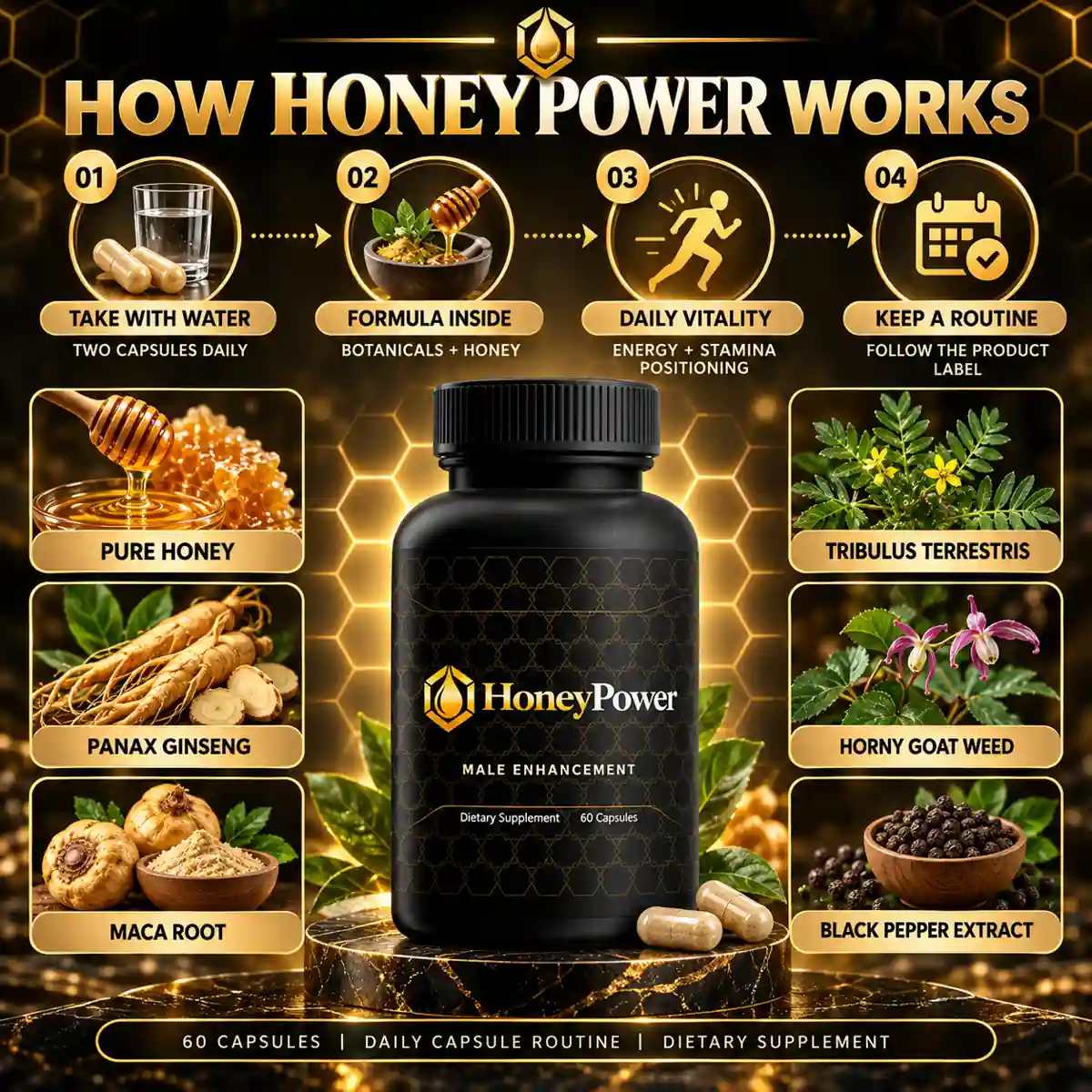
- An erection is a vascular event before it is anything else: nitric oxide relaxes smooth muscle in the penile arteries, blood inflow rises, and venous outflow is compressed to trap it. That is the mechanism "supports circulation" is really pointing at.
- Ginseng has the most direct published vascular research of the six names, including a 2025 systematic review and meta-analysis of ginseng and vascular function, though most of the pooled trials measured markers like flow-mediated dilation rather than erections themselves.
- The American ginseng and endothelial cell study is laboratory work on cultured cells exposed to high glucose, not a trial in men, and it should be read as that.
- Vascular disease is also one of the most common medical causes of erectile dysfunction, so the same mechanism this label references is also the reason a symptom can be a signal worth a doctor's attention rather than a supplement's.
- No published trial has given HoneyPower itself, as formulated, to men and measured a circulation or vascular outcome. Everything below is ingredient-level evidence, not product-level evidence.
What the label says, in one line
The HoneyPower sales page names three things this formula supports: healthy testosterone, as printed, blood circulation, and energy and stamina. Circulation gets one line and no further explanation. It does not say which of the six named ingredients does that job, does not cite a study, and does not define what "supports" means in a physiological sense. That is standard for a structure and function claim on a dietary supplement, and it is also exactly the kind of sentence that benefits from being unpacked rather than taken or dismissed on the strength of its wording alone.
This article does the unpacking in two steps. First, what circulation actually has to do with an erection, mechanically. Second, which of the six named ingredients has published research that touches that mechanism, in what population, and how strong that evidence is.
The actual mechanism: nitric oxide, smooth muscle, and venous trapping
An erection is, at bottom, a plumbing event. The classic physiology, summarized in reviews such as Toda and colleagues' 2005 paper on nitric oxide and penile erectile function, works like this. Sexual stimulation, whether from touch or from thought, triggers the release of nitric oxide from nerve endings and from the lining of blood vessels inside the penis, called the endothelium. Nitric oxide activates an enzyme that raises levels of a molecule called cyclic GMP inside the smooth muscle cells that wrap the penile arteries and the erectile tissue itself. Cyclic GMP relaxes that smooth muscle.
When that smooth muscle relaxes, two things happen at once. The arteries supplying the penis widen, so more blood flows in. And the erectile tissue itself expands, which presses against a tough outer sheath called the tunica albuginea and pinches shut the small veins that would otherwise let blood drain back out. The result is a chamber that fills faster than it can empty. That is the vascular event a drug like sildenafil works on, by blocking the enzyme that breaks down cyclic GMP, and it is the same event any ingredient claiming to support circulation in this context would need to touch in some way.
Older reviews, including Andersson's 2001 paper on the neurophysiology and pharmacology of erection, and a 2010 Spanish-language review on the physiology of erection, describe the same basic sequence from slightly different angles: this is a nerve-triggered, nitric-oxide-mediated, smooth-muscle event, not something that responds to a single input. A more recent 2021 review in Biomolecules on erectile function and sexual behavior places that vascular step alongside hormonal and neurological ones, because in a real man on a real evening, several systems are working together, not one.
So when a label says a formula supports circulation, the specific, falsifiable version of that claim would be: one or more ingredients in this capsule measurably affects nitric oxide availability, endothelial function, or smooth muscle relaxation in the relevant tissue. That is a testable claim. What follows is what has actually been tested, ingredient by ingredient, for the six names on this bottle.
Ginseng and vascular function: the 2025 meta-analysis
Of the six ingredients, Panax ginseng has the deepest and most direct published research connecting it to vascular outcomes in people. A 2025 systematic review and meta-analysis published in BMC Complementary Medicine and Therapies pooled human trials of ginseng supplementation and vascular function. The outcomes it tracked were the kind vascular researchers actually measure: flow-mediated dilation, a standard ultrasound test of how well an artery widens in response to increased blood flow, along with blood pressure and markers of endothelial function.
The review reported measurable improvements in these vascular markers across the pooled trials. That is a real and useful finding, and it is the strongest single piece of evidence connecting any of the six named ingredients to the circulation claim on this label. It is also worth being precise about what it is not. Flow-mediated dilation is a marker of how well a blood vessel in the arm responds to a pressure cuff test. It is a recognized, validated proxy for vascular health, used constantly in cardiology research, but it is a proxy. None of the trials pooled in that meta-analysis measured penile blood flow or erectile function directly. The connection between better flow-mediated dilation in the brachial artery and better blood flow during an erection is physiologically plausible, since both depend on the same nitric-oxide pathway, but plausible is not the same as demonstrated in that specific tissue.
It is also worth noting what the meta-analysis does not tell a reader about HoneyPower specifically: the trials it pooled used varying forms and doses of ginseng extract, none of them the unspecified amount printed as "Panax Ginseng" on this six-ingredient label with no milligram figure attached.
A cell study, not a human trial: what the endothelial work actually measured
A second piece of ginseng-adjacent research worth being honest about is a 2011 paper in Phytomedicine reporting that American ginseng, a related but distinct species from the Panax ginseng named on this label, prevents glucose-induced oxidative stress and dysfunction in endothelial cells exposed to high glucose concentrations in a laboratory dish.
That is legitimate, peer-reviewed research, and it points at a real mechanism: high blood sugar damages the endothelium, the same vessel lining that has to release nitric oxide for an erection to happen, and an antioxidant compound that protects that lining in a dish is a reasonable candidate for further study. But it is exactly what its title says: cultured cells in a laboratory, not people. It cannot tell a reader whether taking a ginseng-containing capsule changes endothelial function in a living man's blood vessels, at any dose. Citing this kind of study as if it were equivalent to a human circulation trial is one of the more common ways supplement marketing overstates its evidence, and this article is naming it plainly so a reader can spot the same move elsewhere.
| Ingredient | Direct vascular / circulation research | What it actually measured |
|---|---|---|
| Panax Ginseng | 2025 meta-analysis, multiple human trials | Flow-mediated dilation, blood pressure, endothelial markers — not penile blood flow directly |
| American ginseng (related species) | 2011 cell-culture study | Endothelial cells in a dish, glucose-induced oxidative stress — not a human trial |
| Maca Root, Tribulus Terrestris, Horny Goat Weed, Black Pepper Extract | No dedicated human circulation/vascular trial found in this search | Research on these four names for this product concentrates on desire, testosterone or bioavailability, covered in the other HoneyPower articles |
This table reflects a targeted PubMed search for each named ingredient plus circulation, vascular function, nitric oxide or endothelial outcomes. It is not a claim that no such research exists anywhere, only that a direct human vascular trial for those four names was not located.
See the full ingredient list next to what each name's research covers
Ginseng carries the vascular research among these six names. The ingredients page sets every name beside the dose and outcome its own published trials used.
One bottle $69 · six bottles $294 · 180-day money-back guarantee
Order HoneyPowerTwo capsules a day · 60 per bottle
Maca, tribulus, horny goat weed and black pepper: what the vascular literature does and does not say
It matters to say plainly what a targeted search did not find, because a circulation claim printed above six ingredient names invites the assumption that all six contribute to it. A search of PubMed for each remaining name alongside terms like vascular function, circulation, nitric oxide and endothelial did not surface a dedicated human trial measuring a circulation or vascular outcome for maca root, tribulus terrestris, horny goat weed (Epimedium), or black pepper extract, in the course of researching this article.
That does not mean these ingredients do nothing relevant to blood flow under any framing. Horny goat weed's active compound, icariin, has a mechanism, inhibiting the enzyme PDE5, that overlaps with the same cyclic-GMP pathway described above, and that mechanism is covered from a different angle, testosterone rather than vascular outcomes specifically, in the Epimedium species article and in the separate icariin mechanism article on this product's sister site. What it means here is narrower: the specific combination of terms this article searched, a named ingredient plus a circulation or vascular endpoint measured in people, returned results for ginseng and did not return a comparable result for the other four names named on this label.
Tribulus terrestris has a body of testosterone research, covered in the tribulus saponin percentage article, and maca has desire and stamina research covered in the maca and stamina article and, on the sister site, the black versus red maca article. Black pepper extract's own documented job is changing absorption of other compounds rather than acting on blood vessels directly, which is the subject of the black pepper article already on this blog.
When circulation is the medical story, not the supplement story
There is a second reason the vascular mechanism above is worth understanding clearly, and it runs the opposite direction from a marketing claim. The same blood vessels that a supplement label references when it says "supports circulation" are also, when they are damaged by disease rather than simply under-supported, one of the most common medical causes of erectile difficulty. A 2025 review on erectile dysfunction in diabetes mellitus lays out how chronically high blood sugar damages the endothelium and reduces nitric oxide availability through the same pathway described above, which is one reason erectile dysfunction is often an early warning sign of cardiovascular disease generally, not only a diabetes complication specifically.
What that means practically: a change in erectile function that developed gradually, over months, alongside other signs like reduced exercise tolerance, is a pattern worth describing to a doctor, because the vascular system involved is the same one that carries blood everywhere else in the body. Nothing about ginseng's flow-mediated-dilation data changes that. A supplement working on the same general pathway a disease can also damage is not a substitute for finding out whether that pathway is damaged in the first place, and the most direct way to find that out is a medical assessment rather than a trial of any capsule.
Reading a circulation claim like this one
Put together, here is what a reader can fairly take from this specific label's circulation line. There is real, human, peer-reviewed evidence that ginseng, the named ingredient with the deepest research base on this bottle, affects vascular markers researchers use as proxies for circulation, in a body of pooled trials substantial enough for a 2025 meta-analysis. There is not a trial measuring penile blood flow directly for any of the six ingredients, and there is not a trial of HoneyPower as formulated measuring any circulation outcome at all. A related-species cell study sometimes cited alongside this topic is laboratory work on cultured cells, not evidence in people. And the same vascular system this claim references is also one of the more common places a genuine medical cause of erectile difficulty shows up, which is a reason to treat a persistent change as a conversation with a doctor rather than only a shopping decision.
None of that makes the printed claim false. A structure and function statement on a supplement label does not require the same evidence a drug claim would, and the asterisk that accompanies statements like this on the benefits panel says as much. What it means is that a reader who wants to judge the circulation line has, in the ginseng meta-analysis, a genuine and specific piece of evidence to weigh it against, and in the absence of comparable data for the other five names, a clearer sense of where that evidence stops.
An erection depends on nitric oxide relaxing smooth muscle in penile arteries and erectile tissue, which increases inflow and traps blood by compressing outflow veins. Of the six named ingredients, ginseng has the strongest published human vascular evidence, from a 2025 meta-analysis measuring flow-mediated dilation and related markers, not penile blood flow directly. A related cell-culture study is laboratory work, not a human trial. No dedicated human vascular trial was found for maca, tribulus, horny goat weed or black pepper extract in this search, and no trial has measured HoneyPower itself on any circulation outcome. The same vascular system is also where genuine medical causes of erectile difficulty, including diabetes-related vascular disease, tend to show up.
References
- Toda N, Ayajiki K, Okamura T. Nitric oxide and penile erectile function. Pharmacol Ther. 2005;106(2):233-54. PMID 15866322. https://pubmed.ncbi.nlm.nih.gov/15866322/
- Andersson KE. Neurophysiology/pharmacology of erection. Int J Impot Res. 2001;13 Suppl 3:S8-17. PMID 11477487. https://pubmed.ncbi.nlm.nih.gov/11477487/
- Physiology of erection. Arch Esp Urol. 2010;63(8):581-8. PMID 20978289. https://pubmed.ncbi.nlm.nih.gov/20978289/
- Erectile Function and Sexual Behavior: A Review of the Role of Nitric Oxide. Biomolecules. 2021;11(4):541. PMID 34944510. https://pubmed.ncbi.nlm.nih.gov/34944510/
- Ginseng supplementation and vascular function: a systematic review and meta-analysis. BMC Complement Med Ther. 2025;25:112. PMID 40646515. https://pubmed.ncbi.nlm.nih.gov/40646515/
- American ginseng (Panax quinquefolius) prevents glucose-induced oxidative stress and endothelial dysfunction. Phytomedicine. 2011;18(13):1110-5. PMID 21840692. https://pubmed.ncbi.nlm.nih.gov/21840692/
- Erectile Dysfunction in Diabetes Mellitus: A Comprehensive Review. Endocrinol Diabetes Metab. 2025. PMID 40960125. https://pubmed.ncbi.nlm.nih.gov/40960125/
Weigh the circulation claim against the ginseng data
Ginseng is first of the six names on this bottle, with no amount printed. Its vascular research is the deepest of the six; the ingredients page sets every name beside its own trial doses.
One bottle $69 · six bottles $294 · 180-day money-back guarantee
Order HoneyPowerTwo capsules a day · 60 per bottle