HoneyPower Official Website › Blog › Tribulus Terrestris
Tribulus Terrestris: The Saponin Percentage Problem
Tribulus terrestris is fourth of six names on this label and, unusually for this aisle, it comes with a genuine quality-control literature behind it. That literature does not settle on a dose. It settles on something more useful and much less talked about: the same plant, sold under the same name, can differ almost forty-fold in the one compound class its activity depends on.
- A 2001 HPLC survey of market tribulus products found protodioscin content ranging from 0.17% to 6.49%, a spread of roughly 38-fold between the weakest and strongest product tested.
- A 2008 chemical survey found Balkan, Turkish, Georgian and Iranian tribulus share one chemical profile, while Vietnamese and Indian tribulus belong to a different one entirely, lacking two of the seven marker compounds found in the first group.
- The one trial that reported a positive result on a sexual-function index standardised its tablets to a stated saponin content. The trial that reported no difference from placebo on the same plant did not state one.
- A 2005 trial gave tribulus directly to young men at 700 to 1,400 mg a day, roughly the top of what a raw-weight capsule delivers, and found no change in androgen production.
- A 2025 laboratory survey of commercial tribulus supplements found some products contained undisclosed PDE5-inhibitor and stimulant compounds not listed on the label.
Why tribulus needs a different kind of question
Every other ingredient article on this website asks the same question: how many milligrams did the trials use, and how does that compare with what a two-capsule serving can physically hold? For ginseng, for maca, that question has a clean answer, because the active material in a gram of ginseng root does not vary in kind from one bag to the next. Tribulus terrestris breaks that pattern, and it is worth being precise about how.
The plant’s presumed activity is attributed to a class of steroidal saponins, chiefly a compound called protodioscin. Unlike a whole herb where “more of the plant” is at least a coherent idea, tribulus sold by weight can contain wildly different amounts of the compound its own marketing is built around, depending on where it was grown, which part of the plant was used, and how it was processed. A milligram figure on a label, if one were printed, would answer a different question than the one a buyer actually needs answered.
What “saponins” means, and why a raw weight cannot capture it
the first published HPLC method for tribulus saponins is also the paper that put a number on the problem. Ganzera and colleagues developed the first analytical method capable of separating and quantifying tribulus’s steroidal saponins, using protodioscin as the marker compound. They then ran it on actual market products.
The result is the single most useful fact in this entire article: analysis of commercial tribulus products found protodioscin content ranging from 0.17% to 6.49% by weight. That is not a rounding difference. A product at the top of that range contains roughly 38 times the concentration of the marker compound as a product at the bottom, gram for gram of the same labelled ingredient.
| What two products both labelled “Tribulus terrestris 500 mg” can actually contain | Protodioscin at 0.17% | Protodioscin at 6.49% |
|---|---|---|
| Protodioscin per 500 mg serving | ≈0.85 mg | ≈32.5 mg |
| Multiple of the weaker product | 1× | ≈38× |
Illustrative arithmetic built from the published 0.17%–6.49% range in Ganzera 2001, applied to a hypothetical 500 mg serving. It is not a claim about any specific product’s actual content, which is precisely the point: without a stated percentage, nobody outside a laboratory can know where a given jar falls in that range.
One plant, at least two chemical identities
a 2008 survey across nine countries went looking for the source of that spread and found something more fundamental than a processing difference. Dinchev and colleagues analysed tribulus samples collected in Bulgaria, Greece, Serbia, Macedonia, Turkey, Georgia, Iran, Vietnam and India by LC-MS/MS, screening for protodioscin and six related compounds.
Samples from Bulgaria, Turkey, Greece, Serbia, Macedonia, Georgia and Iran shared a broadly similar chemical profile, with protodioscin and a related compound called prototribestin as the dominant components. The Vietnamese and Indian samples were chemically different: they lacked two of the seven marker compounds present in the first group, while a compound called tribulosin, largely absent elsewhere, was present in high amounts.
The authors’ own conclusion is worth quoting in substance rather than summarising away: this looks like at least two distinct chemotypes of the same named species, one common across East South Europe and West Asia, and at least one other, still not fully characterised, associated with Vietnamese and Indian material. Two products both truthfully labelled Tribulus terrestris can be, chemically, closer to two different plants than to each other.
The trial that standardised, and the one that did not
This is not an abstract chemistry problem. It shows up directly in the clinical trial record, and comparing two trials side by side makes it concrete.
| Trial | Dose | Saponin standardisation stated | Result |
|---|---|---|---|
| Kamenov 2017 | 1,500 mg a day (two 250 mg tablets, three times daily) | Yes — not less than 112.5 mg furostanol saponins per tablet | Improvement on a validated sexual function index versus placebo |
| Santos 2014 | 800 mg a day | Not stated in the published method | Result reported against placebo; material not chemically specified |
Same plant name, two different trials, and only one of them tells a reader what was actually being measured out.
the Kamenov phase IV trial is the strongest positive result in the tribulus literature partly because of its size and design, and partly because it is reproducible in a way the others are not: another manufacturer could, in principle, match the furostanol saponin content per tablet and expect a comparable material. the Santos placebo-controlled trial ran at a lower raw dose with no published saponin percentage, which means its 800 mg figure cannot be compared against Kamenov’s 1,500 mg on equal terms. They may have delivered similar amounts of active saponin, or very different amounts. The papers themselves do not let a reader work it out.
More milligrams did not move the number that matters
Neychev and Mitev’s direct test is the trial this website’s sibling site has already covered for its sexual-function implications. It is worth returning to here for a narrower reason: the dose. The researchers gave tribulus to young men at 10 and 20 mg per kilogram of body weight per day, which for a seventy-kilogram man works out to roughly 700 to 1,400 mg a day, in three daily intakes — a raw weight at or above what most commercial single-ingredient capsules deliver.
Androgen production did not change. That result does not contradict Kamenov’s positive finding on a sexual-function questionnaire, because the two trials measured different endpoints. But it does make a specific point about raw weight: doubling or tripling the milligrams of unstandardised tribulus did not move serum androgens, which is exactly what the saponin-content research above would predict if the active fraction, rather than the total plant weight, is what does the work.
Not a guarantee of effect — the Neychev trial used a high raw dose of unspecified material and still found nothing on its endpoint. What a stated percentage buys is comparability: the ability to check a product against a published trial dose in the same units the trial reported, the way Kamenov’s 112.5 mg-per-tablet figure lets a reader compare a jar directly. A milligram figure for the whole plant, printed with no percentage, cannot do that job even in principle.
What happens when someone actually tests the market
a 2025 metabolomics survey took the quality-control question further than content percentage and asked what else might be in a tribulus product beyond tribulus. Gođevac and colleagues used untargeted LC-HRMS metabolomics to screen authentic plant material, deliberately spiked samples, and commercial products sold as tribulus supplements.
The deliberately spiked samples confirmed the method could detect added PDE5 inhibitors and anabolic steroids when present. Separately, among the commercial products screened, some contained undisclosed green tea and citrus-derived compounds not listed on their labels, which the authors suggest were likely added to amplify a stimulant effect and support testosterone-related marketing claims. The study also identified a breakdown marker consistent with steroidal saponin degradation from storage or processing.
None of that is a claim about any specific product, and it is not a claim about this one. It is a reason the saponin-percentage question is not merely academic: a category with a documented content spread of nearly forty-fold, sold under a single botanical name with no standard method of on-pack verification, is also a category where a 2025 laboratory survey found undisclosed additions in some products on the shelf.
See where tribulus sits on the HoneyPower label
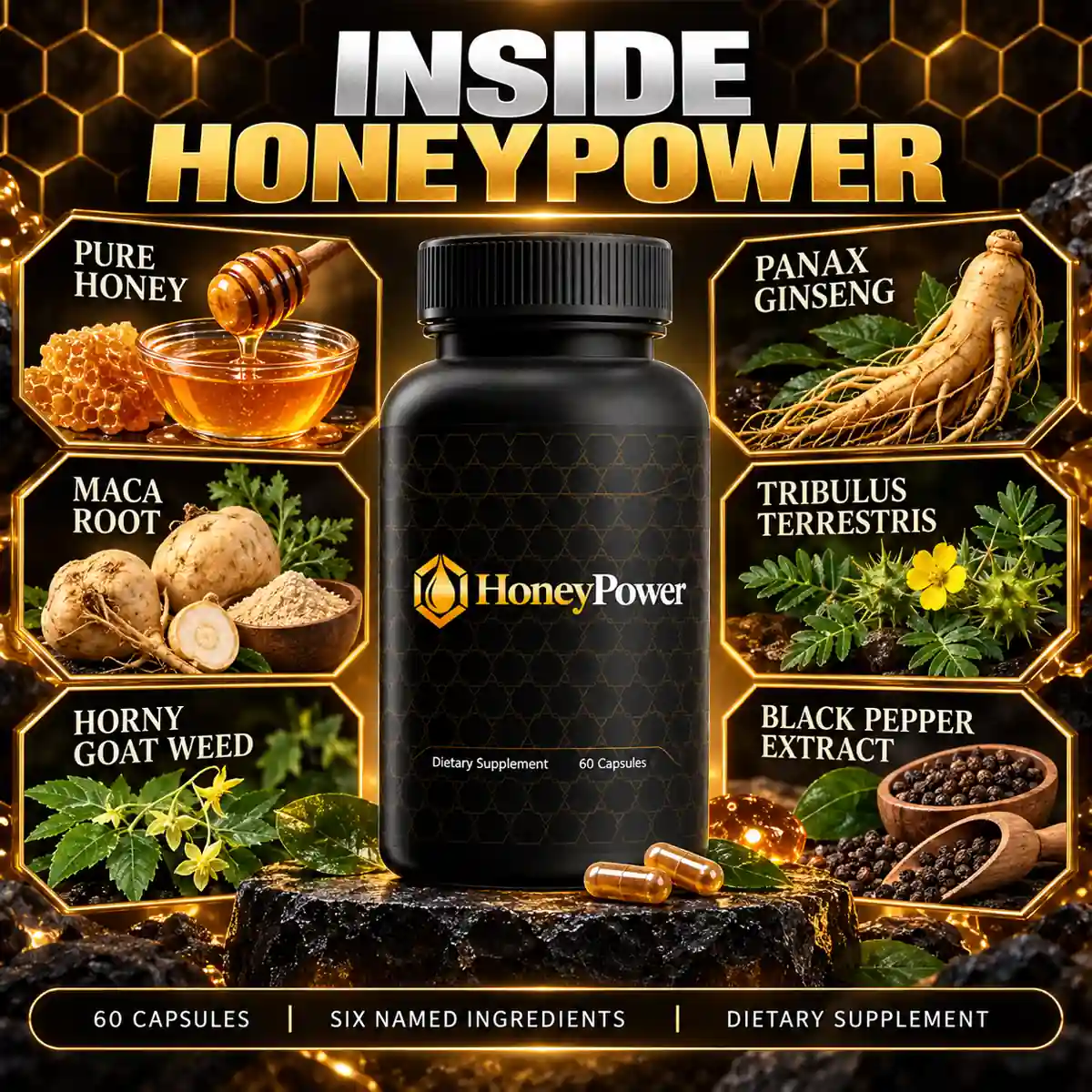
Tribulus Terrestris is named fourth of 6, with no weight, no saponin percentage and no stated sourcing region printed for it. This page exists because that gap is a bigger one for this ingredient than for most of its neighbours on the label.
One bottle $69 · six bottles $294 · 180-day money-back guarantee
Order HoneyPower On The Official WebsiteTwo capsules a day · 60 per bottle · lot HON-26/GE-4888
What this means for a row that names the plant and nothing else
Put the pieces together. The active fraction of tribulus can vary close to forty-fold between products at the same raw weight. The plant itself splits into at least two chemically distinct populations depending on where it was grown. The one clinical trial with a positive, replicable result stated its saponin content per tablet; the trial that did not report a saponin figure cannot be compared against it on equal terms; and a direct test of raw material at a high dose, with no stated standardisation, found no effect on the specific hormone outcome it measured.
A label that prints “Tribulus Terrestris” with no weight and no percentage has, by the numbers above, told a reader the name of a plant that could be almost anything inside that name. That is a stronger version of the gap this website flags on every ingredient page, because for most of the other five names a milligram figure would at least be comparable across brands. For tribulus, even a milligram figure would leave the more important number unanswered.
What a standardisation would need to state, to be useful the way Kamenov’s trial material was useful: the saponin class measured (furostanol saponins, or protodioscin specifically), the percentage by weight, and ideally the source region, since the chemotype data above suggests that matters independently of the percentage. None of those three appear on the artwork this website was built from.
Four questions worth asking of any tribulus row
- Is a saponin percentage stated at all? Not a raw weight of the herb — a percentage of furostanol saponins or protodioscin specifically.
- Where was it grown? The chemotype data suggests Balkan, Turkish, Georgian and Iranian material behaves differently from Vietnamese and Indian material, independent of concentration.
- Does the dose match a standardised trial, or an unstandardised one? Kamenov’s 1,500 mg a day is traceable to a stated saponin content. Many market doses are not traceable to anything.
- Has the product been independently tested for undisclosed additions? The 2025 survey above found some commercial products contained compounds not on their labels.
Tribulus terrestris is not a case where the trials disagree about a dose. It is a case where the same raw weight of plant material can differ nearly forty-fold in the compound class its activity is attributed to, before any question of milligrams is even asked. A label that names the plant and stops there has given a reader less information than it looks like it has, and the one trial in this category with a clean, replicable positive result is also the one that told readers exactly what percentage it was testing.
Related reading: How A Trial Measures Erectile Function: The IIEF, In Plain English explains how the questionnaire score behind these trial results is built and read.
References
- Ganzera M, Bedir E, Khan IA. Determination of steroidal saponins in Tribulus terrestris by reversed-phase high-performance liquid chromatography and evaporative light scattering detection. J Pharm Sci. 2001;90(11):1752-8. PMID 11745732. Market products tested at 0.17% to 6.49% protodioscin. https://pubmed.ncbi.nlm.nih.gov/11745732/
- Dinchev D, Janda B, Evstatieva L, Oleszek W, Aslani MR, Kostova I. Distribution of steroidal saponins in Tribulus terrestris from different geographical regions. Phytochemistry. 2008;69(1):176-86. PMID 17719068. https://pubmed.ncbi.nlm.nih.gov/17719068/
- Kamenov Z, Fileva S, Kalinov K, Jannini EA. Evaluation of the efficacy and safety of Tribulus terrestris in male sexual dysfunction – A prospective, randomized, double-blind, placebo-controlled clinical trial. Maturitas. 2017;99:20-26. PMID 28364864. Dose: 1,500 mg a day, standardised to not less than 112.5 mg furostanol saponins per tablet. https://pubmed.ncbi.nlm.nih.gov/28364864/
- Santos CA Jr, Reis LO, Destro-Saade R, et al. Tribulus terrestris versus placebo in the treatment of erectile dysfunction: A prospective, randomized, double blind study. Actas Urol Esp. 2014;38(4):244-8. PMID 24630840. Dose: 800 mg a day in two doses for 30 days; no saponin standardisation stated. https://pubmed.ncbi.nlm.nih.gov/24630840/
- Neychev VK, Mitev VI. The aphrodisiac herb Tribulus terrestris does not influence the androgen production in young men. J Ethnopharmacol. 2005;101(1-3):319-23. PMID 15994038. Dose: 10 and 20 mg per kg of body weight per day — roughly 700 to 1,400 mg for a 70 kg man. https://pubmed.ncbi.nlm.nih.gov/15994038/
- Gođevac D, Jeremić JS, Cvetković M, et al. LC-MS-based metabolomics for detecting adulteration in Tribulus terrestris-derived dietary supplements. Food Chem X. 2025;27:102476. PMID 40290465. https://pubmed.ncbi.nlm.nih.gov/40290465/
Order HoneyPower with the tribulus numbers in front of you
Three packs, 180 days from purchase, and the trial data printed beside every one of the six names on the ingredients page.
One bottle $69 · six bottles $294 · 180-day money-back guarantee
Order HoneyPower On The Official WebsiteTwo capsules a day · 60 per bottle · lot HON-26/GE-4888