HoneyPower Official Website › Blog › Epimedium And Horny Goat Weed
Epimedium: The Species Problem Behind Horny Goat Weed
“Horny goat weed” is a common name, not a species. The Chinese Pharmacopoeia officially recognises five separate Epimedium species under that name, and published testing shows they do not all contain the same amount of the compound the supplement industry is actually selling. This is the question a label that just says “Horny Goat Weed” leaves entirely open.
- The compound most closely tied to horny goat weed’s reputation is icariin, shown in vitro to inhibit PDE5, the same enzyme family targeted by prescription erectile-dysfunction drugs.
- The Chinese Pharmacopoeia (2015 edition) recognises five distinct Epimedium species as legitimate sources of the herb sold as horny goat weed.
- A 2021 HPLC survey found icariin content varies by both species and growing region, with one regional strain of one species testing highest of everything sampled.
- A drying and heating step commonly used in processing changed icariin content by as much as one to three times in some species and barely moved it in others.
- A 2022 case series identified Epimedium koreanum specifically, rather than the genus generally, as the source material behind a cluster of liver injury cases.
The compound behind the common name
Horny goat weed’s reputation rests almost entirely on one flavonoid glycoside: icariin. a 2006 laboratory study found that icariin inhibits phosphodiesterase-5 (PDE5) activity and raises cyclic GMP levels in cavernous smooth muscle cells taken from rats — the same enzyme family that prescription drugs such as sildenafil are built to block. That finding, run in cells rather than in a person, is the mechanistic basis for almost everything marketed under this common name.
This website’s sister site has already covered the wider evidence gap between that in-vitro finding and any human trial of icariin against an erection endpoint, so it will not be repeated at length here. What has not been covered anywhere on this network is a narrower and, for a buyer holding a specific bottle, arguably more practical question: horny goat weed is not one plant. It is several, and they do not all deliver icariin at the same rate.
Five species, one Pharmacopoeia entry, one common name
a 2019 study on icariin content across processing methods states the botanical scope plainly: the Chinese Pharmacopoeia, 2015 edition, lists five Epimedium species as recognised sources of the crude drug commonly sold in English as horny goat weed.
| Recognised species | Common thread |
|---|---|
| Epimedium brevicornu | One of five species the Pharmacopoeia treats as an acceptable source |
| Epimedium sagittatum | The species most often specified by name in supplement literature |
| Epimedium pubescens | Recognised source, distinct flavonoid profile |
| Epimedium koreanum | Recognised source; also the species named in a 2022 liver-injury case series (see below) |
| Epimedium wushanense | Recognised source, geographically restricted |
Five botanically distinct plants, all legitimately sold under the single English common name “horny goat weed,” none of them named on this label.
A supplement label that prints “Horny Goat Weed” or even “Epimedium” with no species epithet has told a reader which genus it came from and nothing about which of the five recognised species is inside the capsule. That would matter less if the five behaved identically. They do not.
Same species, different ground: the 2021 survey
a 2021 HPLC-DAD survey across major Eastern Asian producing areas collected nine sets of Epimedium material representing different species and cultivation regions, then quantified three major bioactive flavonoid compounds, including icariin, using HPLC combined with multivariate statistical analysis.
Both species and geographical origin independently and significantly influenced the concentration of the bioactive compounds measured. Material from the same species clustered together on the statistical analysis, and material from the same region clustered together, but the two effects were separate and both were real. In this survey, Epimedium sagittatum sourced from Sichuan showed the highest content of bioactive compounds of everything sampled, ahead of the same species grown elsewhere.
a separate 2012 study on a specific accession reinforces the same point from a different angle: a particular local population of Epimedium sagittatum found in Luotian county, Hubei province, tested measurably higher in total flavonoids than other populations of the same named species, and the researchers found significant correlation between flavonol glycoside content and geographic location specifically, independent of species identity.
Species matters. Region matters separately from species. A capsule that names only the common name “horny goat weed” has not told a reader which of at least two variables that drive icariin content it is working with, let alone both.
What happens to the number during processing
The 2019 study introduced above did not stop at comparing raw species. It tested what a standard processing step — baking at 150°C for 30 minutes, a common preparation method — does to icariin content across all five recognised species side by side.
The effect was not uniform. In several species, icariin content increased by roughly one to three times after the heating step, apparently because a related, less bioactive compound converted into icariin under those conditions. In other species tested in the same study, the same heating step produced only a slight increase, or, in at least one case, a slight decrease. The direction and size of the change depended on which species was being processed, not on the processing step alone.
That is a second axis of variation stacked on top of the first. Two capsules could start from the same recognised species, be grown in comparable conditions, and still finish with different icariin content purely because of how the raw material was dried and processed before encapsulation.
See where horny goat weed sits on the HoneyPower label
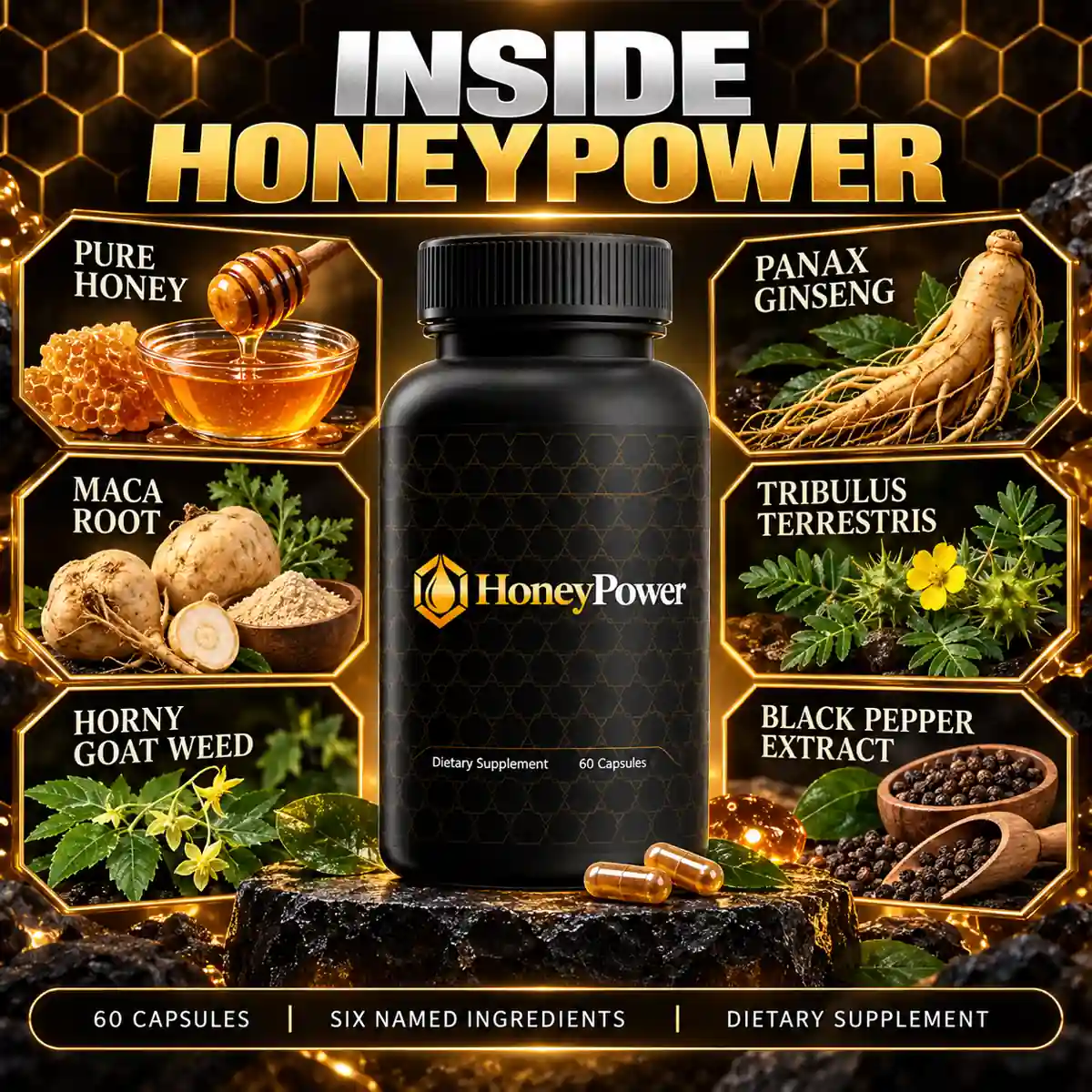
Horny Goat Weed is named fifth of 6, with no species, no growing region and no icariin percentage printed for it. This page exists because, for this particular name, that is three open questions rather than one.
One bottle $69 · six bottles $294 · 180-day money-back guarantee
Order HoneyPower On The Official WebsiteTwo capsules a day · 60 per bottle · lot HON-26/GE-4888
The species that mattered in a liver-injury case series
Species identity is not only a potency question. a 2022 mechanistic study using untargeted metabolomics examined a cluster of liver injury cases and traced the implicated material specifically to Epimedium koreanum, one of the five Pharmacopoeia-recognised species, rather than to the Epimedium genus in general.
That distinction matters for how a reader should treat this whole family of ingredient rows. The finding is not a reason to treat every Epimedium species as carrying the same risk profile; it is a reason species identity is not a purely academic detail. A crude drug traded internationally under one common English name, sourced from five botanically distinct plants with different chemical and, in at least one documented case, different safety profiles, is a name that hides more than it discloses when a label stops at the common name.
A genus-wide caveat that applies to the whole aisle
a 2015 clinical review written for urologists surveyed the top-selling men’s sexual health nutraceuticals, horny goat weed among them, and its blunt conclusion about the category as a whole is worth carrying into this specific ingredient: there is little regulation on the dosage, purity or exact ingredient identity found in these products, and the review authors described the supporting medical literature across the category as generally of low quality.
That is a statement about the industry, not a statement about this one bottle. But it explains why a species name, a growing region and a stated icariin percentage would all be verifiable, checkable facts if a label printed them, and why their absence is not a minor omission on an ingredient this variable.
What a bare common name leaves unanswered
Stack the findings. Five species share one common name. Species and growing region each independently move icariin content, sometimes to the point that one regional strain outperforms every other sample tested. Processing can multiply or barely touch that number, depending again on species. And in at least one documented safety case, the species mattered enough to be the paper’s own headline finding.
A row that reads “Horny Goat Weed” with nothing else printed beside it has therefore left at least three separate, independently documented sources of variation unaddressed: which of five species, grown where, processed how. None of the three appear on the artwork this website was built from.
None of this is a reason to assume the worst about any specific bottle. It is a reason to notice that, for this one name among the six on the label, the industry-standard fix already exists and is already in use elsewhere in botanical supplements: a stated species (by full botanical name, not the genus alone), a stated country or region of origin, and a stated percentage of the marker compound, exactly the three data points a buyer would need to place a given jar somewhere on the ranges documented above. Ginseng labels that specify Korean red ginseng standardised to a ginsenoside percentage do this routinely, as this website’s own ginseng article describes. Nothing about Epimedium makes the same practice harder to apply; it is simply not applied on the artwork behind this bottle.
Four questions worth asking of any horny goat weed row
- Which species? Epimedium brevicornu, sagittatum, pubescens, koreanum and wushanense are not interchangeable on the evidence above.
- Grown where? Region moved content independently of species in two separate studies.
- Standardised to what icariin percentage? Without one, a milligram figure for the raw herb tells a reader very little.
- Is the species identity independently verifiable? A 2022 case series shows species identity was, in that instance, a safety-relevant fact rather than a cosmetic one.
“Horny goat weed” is a trade name for five recognised species that differ in icariin content by growing region and by processing method, and at least once in the published literature, by safety profile. A label that stops at the common name has answered none of those questions, and the evidence above is the reason this ingredient deserves a more specific question than the milligram figure this website usually asks first.
References
- Ning H, Xin ZC, Lin G, Banie L, Lue TF, Lin CS. Effects of icariin on phosphodiesterase-5 activity in vitro and cyclic guanosine monophosphate level in cavernous smooth muscle cells. Urology. 2006;68(6):1350-4. PMID 17169663. https://pubmed.ncbi.nlm.nih.gov/17169663/
- Sun XG, Zhou M, Ma BP, Guo BL. Change of icariin content in five Epimedium species by heating process. Zhongguo Zhong Yao Za Zhi. 2019;44(9):1857-1861. PMID 31342713. https://pubmed.ncbi.nlm.nih.gov/31342713/
- Li B, Lima MRM, Nie Y, Xu L, Liu X, Yuan H, Chen C, Dias AC, Zhang X. HPLC-DAD Fingerprints Combined With Multivariate Analysis of Epimedii Folium From Major Producing Areas in Eastern Asia: Effect of Geographical Origin and Species. Front Pharmacol. 2021;12:761551. PMID 34899314. https://pubmed.ncbi.nlm.nih.gov/34899314/
- Liang Q, Wei G, Chen J, Wang Y, Huang H. Variation of medicinal components in a unique geographical accession of horny goat weed Epimedium sagittatum Maxim. (Berberidaceae). Molecules. 2012;17(11):13345-56. PMID 23138537. https://pubmed.ncbi.nlm.nih.gov/23138537/
- Li P, Zhang L, Guo Z, Kang Q, Chen C, Liu X, Ma Q, Zhang J, Hu Y, Wang T. Epimedium koreanum Nakai-Induced Liver Injury-A Mechanistic Study Using Untargeted Metabolomics. Front Pharmacol. 2022;13. PMID 35910368. https://pubmed.ncbi.nlm.nih.gov/35910368/
- Cui T, Kovell RC, Brooks DC, Terlecki RP. A Urologist's Guide to Ingredients Found in Top-Selling Nutraceuticals for Men's Sexual Health. J Sex Med. 2015;12(11):2105-17. PMID 26531010. https://pubmed.ncbi.nlm.nih.gov/26531010/
Order HoneyPower with the species question in front of you
Three packs, 180 days from purchase, and the trial data printed beside every one of the six names on the ingredients page.
One bottle $69 · six bottles $294 · 180-day money-back guarantee
Order HoneyPower On The Official WebsiteTwo capsules a day · 60 per bottle · lot HON-26/GE-4888