HoneyPower Official Website › Blog › Maca And Stamina
Maca And Stamina: What The Athlete Trials Measured
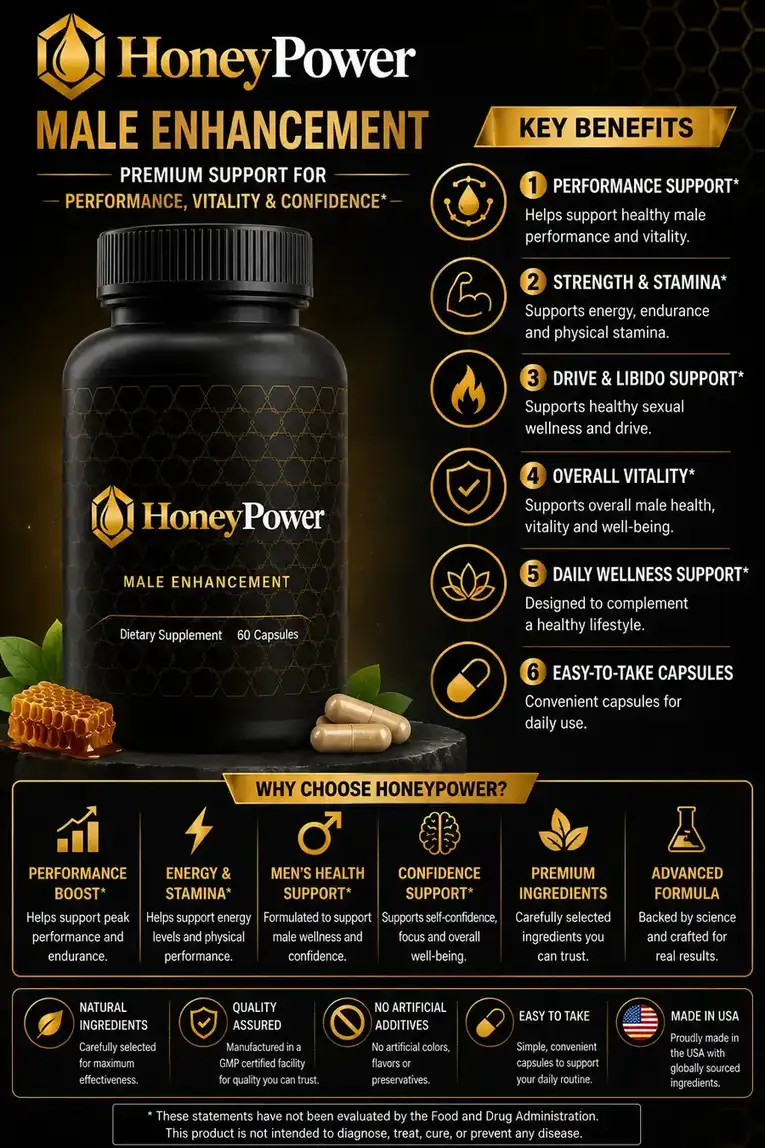
The HoneyPower benefits panel lists strength and stamina second, and maca is the third of the six names on the bottle. So what did maca do when it was given to people who actually train? Four small human trials answer that question, and the four answers do not agree. This is what each one measured, what it found, and what it cannot tell you.
- Maca is a Peruvian root, and its best-known human research is about sexual desire. The stamina literature is a separate, smaller and much newer pile.
- Eight trained cyclists improved a 40 km time trial against their own baseline after 14 days of maca extract, but not against placebo.
- Ten trained basketball players took 2,000 mg a day for two weeks and showed no difference from placebo on jumping, shooting, sprinting, fatigue or lactate clearance.
- Eight elite handball players on a concentrated black maca extract improved on a shuttle run and several strength measures, in a study small enough that one player is an eighth of the data.
- A 2024 meta-analysis reports large effects on endurance measures, but its listed outcomes are mostly rodent tests, so it does not settle the human question.
What the panel claims, and what it does not
Start with what is actually printed, because it is easy to argue with a claim nobody made. The benefits panel that ships with HoneyPower carries six numbered lines. The second reads strength and stamina, supports energy, endurance and physical stamina, and it carries an asterisk pointing to the standard statement that these claims have not been evaluated by the Food and Drug Administration. The how-it-works sheet repeats the idea in its third step, labelled daily vitality, with the words energy plus stamina positioning. The seller's own paperwork names energy and stamina among the things the product supports.
None of that mentions maca. The panel does not say which of the six ingredients is doing which job, and the label prints no amount for any of them. So the connection between maca and the stamina line is an inference, and the reasonable way to test an inference is to look at what the research on the named ingredient found. That is the only exercise this article attempts.
It is a different question from the one the maca dose article answers. That article is about sexual desire, hormones and the 3,000 mg threshold. Here the outcome is physical performance: how fast a cyclist covers 40 kilometres, how high a basketball player jumps, how a handball player runs a shuttle. Desire and endurance may or may not share a mechanism. Nothing in the published work shows that they do.
Eight cyclists, one improvement that placebo matched
The earliest human study in this area is a pilot from 2009 by Stone and colleagues. It was designed by people who had noticed that maca is sold two ways: as a sports supplement for strength and endurance athletes, and as a natural aid to sexual drive. The authors noted that whether either benefit had scientific merit was not yet known.
Eight trained male cyclists each completed a 40 kilometre cycling time trial before and after 14 days of supplementation, once with maca extract and once with placebo, in a randomised cross-over design. They also completed a sexual desire inventory at each visit.
The result has two halves, and the way they split is the whole lesson. After maca, the cyclists rode the 40 km faster than at their own baseline (P = 0.01). But compared with the placebo trial after supplementation, the difference was not significant (P above 0.05). Placebo delivered much the same improvement. Sexual desire scores, by contrast, rose against baseline (P = 0.01) and against placebo (P = 0.03).
Read that again slowly, because it is the single most useful thing in this literature. A before-and-after comparison showed a faster ride. A fair comparison, against a placebo taken for the same 14 days, showed no reliable difference in the ride and a difference in desire. If the study had been reported as a simple before-and-after, it would have looked like a stamina finding. The cross-over design is what protected the reader from that mistake. The authors themselves called the results promising and asked for longer trials with more volunteers, which is the right response to eight people and two weeks.
Ten basketball players and a clean null
Sixteen years later, Wu and colleagues published a study built to test a specific idea. Animal work had suggested maca might reduce exercise-induced fatigue by improving how quickly the body clears lactate. So they hypothesised that maca would improve performance in well-trained players doing intermittent exercise, and tested it in basketball.
It was a randomised, placebo-controlled cross-over trial in ten well-trained college male basketball players. Each took either 2,000 mg a day of maca or a placebo for two weeks. Performance was assessed with a countermovement jump test, a basketball jump-shooting accuracy test and a repeated sprint ability test, and blood lactate clearance was measured.
The abstract is unusually blunt. There were no significant differences between the maca and placebo conditions in jump height (P = 0.352), jump-shooting accuracy, repeated sprint performance, fatigue index (P = 0.266) or blood lactate clearance rate (P = 0.258). The authors concluded that two weeks of maca supplementation did not provide ergogenic benefits for performance or fatigue in well-trained basketball players.
Two features make this study easy to underrate. It tested the hypothesis its own authors proposed and reported the negative result plainly. And it used a dose, 2,000 mg a day, that is stated outright, which is exactly what the HoneyPower label does not do for maca. A reader can look at that number and ask whether the bottle in front of them plausibly resembles it. On this label nobody can, because the amount of maca in two capsules is not printed.
| Trial | Who | Dose and length | Against placebo |
|---|---|---|---|
| Stone 2009 | 8 trained male cyclists | Maca extract, 14 days | 40 km time not different; desire score higher |
| Wu 2025 | 10 well-trained male basketball players | 2,000 mg a day, 2 weeks | No difference on jumping, shooting, sprinting, fatigue or lactate |
| Kang 2023 | 8 elite female adolescent handball players | 2,500 mg concentrated black maca extract, 4 weeks | Better shuttle run and several isokinetic measures |
| Weng 2025 | 20 healthy men | 2.25 g of extract twice a day, 12 weeks | Interferon gamma higher; no other positive effect reported |
Every figure above is taken from the trial's own abstract. The four trials used different outcomes, so they cannot be pooled into a single number.
Eight handball players and a positive result
Not every trial in the group is negative, and leaving out the positive one would make this a rigged article. Kang and colleagues recruited eight elite female adolescent handball players for a placebo-controlled cross-over study. The capsules contained 2,500 mg of a 100 percent concentrated black maca extract or a placebo, taken for four weeks, and isokinetic muscle performance and physical fitness were measured three times at four-week intervals.
After black maca supplementation the players improved significantly on the 20 metre shuttle run (P below 0.001) and on several isokinetic measures of the trunk and knee. Post hoc analysis showed the black maca results were higher than both the players' own baseline and the placebo condition on those measures. The authors concluded that black maca could improve performance in athletes doing high-intensity movements.
That is a real finding and it is worth taking seriously. It is also worth reading the numbers around it. Eight athletes, one team's worth, adolescents, all women, all elite, on a product described as a 100 percent concentrated extract at 2,500 mg. The study cannot tell you whether a man of forty who runs for exercise would see the same thing, and it cannot tell you what an unspecified maca share of a mixed capsule would do. It also used black maca specifically. It used black maca specifically, and the HoneyPower label names maca root and no color.
Twelve weeks, a large dose, and one immune marker
The longest human study in this group asked a different question. Weng and colleagues recruited twenty healthy men, matched them in pairs by maximal oxygen consumption, and assigned them to maca or placebo. Everyone took 2.25 g of maca extract or placebo twice a day for 12 weeks and then performed an exhaustive endurance exercise session. Blood was drawn before, immediately after, and at 2, 4 and 24 hours after.
The design was about immune function after hard exercise, not about how far or how fast anyone went. The single difference was interferon gamma secreted by blood mononuclear cells, which was higher in the maca group immediately after exercise and at 24 hours. The authors reported that maca had positive effects only on that one marker.
Two lessons come out of it. A 12-week study at 4.5 grams a day is a serious dose over a serious span, and it did not produce a general performance signal. And a biomarker moving is not the same thing as feeling or performing better. It is a lab value, and it is reported as one.
See where maca sits on the HoneyPower label
Maca root is third of the six names, with no amount, no color and no extract ratio printed. The ingredients page sets the research doses beside the names.
One bottle $69 · six bottles $294 · 180-day money-back guarantee
Order HoneyPower On The Official WebsiteTwo capsules a day · 60 per bottle · lot HON-26/GE-4888
The meta-analysis, and why it reads bigger than it is
If you search for maca and endurance you will meet a 2024 paper that sounds decisive. Huerta Ojeda and colleagues published a systematic review and meta-analysis of maca and physical performance in animals and in humans. They included 21 studies in the review and 16 in the meta-analysis, and they reported a large effect on every outcome they pooled: standardised mean differences of 2.26 for the forced swimming test, 6.26 for the rota-rod test, 5.23 for the grip strength test, and negative values for lactic acid, meaning lower. They also reported a greater effect at higher doses.
Those are impressive numbers, and the reason to slow down is in the list of outcomes. The forced swimming test and the rota-rod test are tests run on laboratory rodents. The authors said their methodological assessment used a tool designed for animal studies alongside one for human studies, which tells you the pool is a mixture. None of the four human trials above is a forced swimming test, and a reader who sees a standardised mean difference of six should not picture a cyclist.
The paper is useful for what it does establish. There is a body of animal work suggesting maca constituents, the authors point to macamides, affect performance measures in rodents, with a dose-response pattern. That is a reason for the human trials to have been run, and they were. It is not a substitute for their results, and the human results are mixed.
Reading four trials together
Lay the four human trials next to each other and the picture is honest but unglamorous.
- Against placebo, on the outcome that most resembles stamina, the cyclists showed no reliable difference and the basketball players showed none either. The two studies that used a straightforward performance test with a proper control came out flat.
- The positive result came from eight elite handball players on a concentrated black maca extract at 2,500 mg, using a shuttle run and isokinetic tests.
- The longest study found a single immune marker moving after a large daily dose for 12 weeks.
- All four are small. Eight, ten, eight and twenty people. A study of that size can find an effect and can miss one, and neither outcome is conclusive.
Add the fact that doses and forms vary from a stated 2,000 mg to a 100 percent concentrated extract to 4.5 grams a day of extract, and it becomes clear why nobody can say what maca does for stamina in general. What can be said is narrower and more useful: the best-controlled human trials have not shown a dependable performance benefit, the one clearly positive study was tiny and used a specific form, and any panel that lists an energy and stamina line is standing on evidence that is thinner than the wording suggests.
That does not make the line false, and this article does not claim it is. A dietary supplement can carry a structure and function statement without proving it in a trial, and the asterisk on the panel says as much. What it means is that a reader who wants to judge the claim has the four studies above to judge it against, and that is a fairer basis than the wording alone.
If the maca question is really about drive rather than endurance, the desire trials tell a different story, and it is one the maca dose article tells in full. If it is about ginseng, which has the deeper research base of the six names, the ginseng dose article is the place to start.
Four questions worth asking of any stamina claim
- Compared with what? A faster time than last month proves nothing until it is set against a placebo taken for the same period. The cyclists' study is the textbook case.
- How many people? Eight, ten and twenty are pilot sizes. Take them as reasons to run larger trials, not as reasons to expect a result.
- Which form and how much? Root powder, a concentrated extract, black or red or yellow, 2,000 mg or 4,500 mg. A label that prints none of these leaves the question unanswerable.
- Was the outcome a performance or a lab value? Interferon gamma is not a lap time. Both are legitimate, and they are not interchangeable.
The published human research on maca and physical performance is small, mixed and short. Two placebo-controlled trials in trained athletes found no dependable difference, one small trial in eight handball players found improvement on a concentrated black maca extract, and a 12-week trial found one immune marker moved. The stamina line on the benefits panel is the seller's positioning, marked with an asterisk, and it is not something these trials establish.
References
- Huerta Ojeda Á, Rodríguez Rojas J, Cancino-López J, Barahona-Fuentes G, Pavez L, Yeomans-Cabrera MM, et al. Effects of Maca (Lepidium meyenii Walp.) on Physical Performance in Animals and Humans: A Systematic Review and Meta-Analysis. Nutrients. 2024;17(1). PMID 39796542. https://pubmed.ncbi.nlm.nih.gov/39796542/
- Kang S, Ahn BO, Park MH, Lim ST, Lee E. Effects of Black Maca supplement on isokinetics muscular performance of elite women's handball players: placebo-controlled, crossover study. Food Nutr Res. 2023;67. PMID 38187794. https://pubmed.ncbi.nlm.nih.gov/38187794/
- Stone M, Ibarra A, Roller M, Zangara A, Stevenson E. A pilot investigation into the effect of maca supplementation on physical activity and sexual desire in sportsmen. J Ethnopharmacol. 2009;126(3):574-6. PMID 19781622. https://pubmed.ncbi.nlm.nih.gov/19781622/
- Weng PW, Chung YC, Lin TC, Hsu PC, Yang CT, Lin S, et al. Enhancement of Interferon-γ Secretion by Lepidium meyenii Extract Supplementation After Exhaustive Endurance Exercise in Healthy Men: A Double-blind, Placebo-controlled Trial. Int J Med Sci. 2025;22(2):398-408. PMID 39781531. https://pubmed.ncbi.nlm.nih.gov/39781531/
- Wu PS, Wu SH, Jiang RS, Chen CH, Chen BW, Chiu CH. The Impact of Lepidium meyenii (MACA) Supplementation on Basketball-related Performance and Antifatigue Ability: A Double-blind Crossover Study. J Physiol Investig. 2025;68(5):297-304. PMID 40960048. https://pubmed.ncbi.nlm.nih.gov/40960048/
Judge the stamina line by its research
Maca is third of the six names on this bottle, with no amount printed. Three bottles is twelve weeks, the span the longer maca trials ran, and the 180-day window covers it.
One bottle $69 · six bottles $294 · 180-day money-back guarantee
Order HoneyPower On The Official WebsiteTwo capsules a day · 60 per bottle · lot HON-26/GE-4888