HoneyPower Official Website › Blog › The Ginseng Dose
3,000 mg: The Ginseng Dose Almost Every Trial Used
Panax ginseng is the best-evidenced botanical in this whole category and it is also the one whose evidence is most often quoted without its dose. Every positive trial named a number. Not one of those numbers was small, and the gap between them and a blend capsule is the single most useful thing a buyer can know.
- A 2021 Cochrane review pooled nine trials in 587 men and found a benefit on erectile function scores, rating the certainty of that evidence as low.
- The three trials most often cited ran at 3,000 mg, 2,000 mg and 1,400 mg a day.
- A twelve-week exercise trial separated 500 mg of a ginsenoside complex from 100 mg. The larger dose moved the endpoint and the smaller one did not.
- The one trial that measured hormones directly, at three grams a day, found testosterone unchanged.
- Ginseng reduced the effect of warfarin in a randomised trial, which makes it the clearest interaction on any label carrying it.
What the Cochrane review actually says
the 2021 Cochrane review is the most authoritative single document on this question. It pooled nine randomised trials covering 587 men and reported that ginseng improved erectile function scores compared with placebo.
That is a positive finding and it deserves to be reported as one. What deserves equal billing is the certainty rating the reviewers attached to it, which was low. The included studies were small, several were poorly reported, and the review authors were explicit about both.
A low-certainty positive result is not nothing. It is a reason to take an ingredient seriously and a reason to be modest about how much weight it can carry. Both halves of that sentence come from the same document.
The doses, trial by trial
The reason a dose table is more useful than a summary is that the summary travels and the doses do not. Here is what the individual trials behind that review actually ran.
| Trial | Preparation | Daily dose | Length | Population |
|---|---|---|---|---|
| de Andrade 2007 | Korean red ginseng | 3,000 mg | 12 weeks | Men with erectile dysfunction |
| Kim 2009 | Tissue-cultured mountain ginseng extract | 2,000 mg | 8 weeks | 143 men with erectile dysfunction |
| Choi 2013 | Korean ginseng berry extract | 1,400 mg | 8 weeks | Men with erectile dysfunction, multicentre |
| Lee 2018 | Ginsenoside complex UG0712 | 500 mg against 100 mg | 12 weeks | Healthy adults on a supervised exercise programme |
Four trials, four different preparations of the same plant, and four different doses. The last row is the only one that tested two doses against each other.
the Sao Paulo trial at 3,000 mg a day is the study most often pointed at, and it ran at three grams a day of Korean red ginseng for twelve weeks in men with erectile dysfunction. a 143-man trial at 2,000 mg a day ran two grams a day of a tissue-cultured mountain ginseng extract in 143 men over eight weeks. the ginseng berry study at 1,400 mg a day ran 1.4 grams a day of a berry extract across multiple centres.
The smallest of those three is 1,400 mg a day of a single ingredient. That figure alone would fill two large capsules with nothing else in them.
One species name, five different ingredients
There is a second problem hiding inside the first, and it is the one that catches careful readers out. Panax ginseng is a species. It is not an ingredient specification, and the trials above did not all test the same material.
| Preparation | What it is | Why the difference matters |
|---|---|---|
| Korean red ginseng | Steamed and dried root, which changes its ginsenoside profile | It is the preparation behind most of the positive erectile-function work |
| White ginseng | Air-dried root without the steaming step | A different ginsenoside profile, and much less trial evidence in this indication |
| Ginseng berry extract | The fruit rather than the root | A distinct compound profile; tested separately and at a different dose |
| Tissue-cultured extract | Grown in culture rather than harvested from soil | Consistent material, tested on its own terms at 2,000 mg a day |
| “Panax ginseng” with nothing after it | Unspecified | Could be any of the above. The species name alone does not identify the material |
Five materials, one species name. A label that prints only the species has told you the plant and not the ingredient.
Red ginseng is steamed before drying, which alters its ginsenoside profile enough that the pharmacology textbooks treat it separately from white ginseng. Berry extract comes from the fruit rather than the root and has its own compound profile. Tissue-cultured extract is grown rather than harvested.
So a label printing Panax ginseng and stopping there has identified the plant and left the ingredient open. A label printing Korean red ginseng standardised to a stated ginsenoside percentage, at a stated weight, has told you something you can compare against a trial. The distance between those two labels is large.
The trial that separated a big dose from a small one
a 12-week exercise trial that separated 500 mg from 100 mg is unusual and useful. Rather than testing one dose against placebo, it ran a high-dose ginsenoside complex against a much smaller one over twelve weeks in healthy adults following a supervised exercise programme, with physical performance as the endpoint.
The larger dose produced a measurable improvement. The smaller one did not. That is a threshold, demonstrated inside a single trial rather than inferred by comparing two separate studies, and thresholds are exactly what a buyer holding a capsule needs.
It also gives a rough sense of where the floor sits. The comparison in that study was five hundred milligrams against one hundred, of a concentrated ginsenoside preparation rather than whole root, and the hundred did nothing measurable.
An average effect tells you what happened at one dose. A threshold tells you what happens below it, which is the question anybody reading a small number on a panel is actually asking. This category has very few of them, so the two that exist -- this one and the maca dose-finding study -- are worth more than their citation counts suggest.
What ginseng did not do
The commonest misreading of ginseng in this aisle is hormonal, and it is worth correcting directly. the one hormone trial at 3 g a day gave three grams a day to men with metabolic syndrome and measured reproductive hormones alongside mitochondrial DNA copy number. Testosterone did not change.
Whatever the mechanism behind the erectile-function findings is, it is not a testosterone effect. That matters because a great deal of marketing in this category runs the two together, and a reader who buys ginseng expecting a hormone change is buying it for a reason the research does not support.
The interaction worth knowing before you start
the warfarin trial is a randomised controlled trial in healthy volunteers that measured what happened to warfarin's anticoagulant effect when ginseng was added. The effect was reduced.
That is a real, measured, clinically meaningful interaction rather than a theoretical one, and anybody taking warfarin has a specific reason to raise a ginseng-containing supplement with whoever manages their anticoagulation before starting it. Naming the interaction once, precisely, is more use than a general caution repeated on every page.
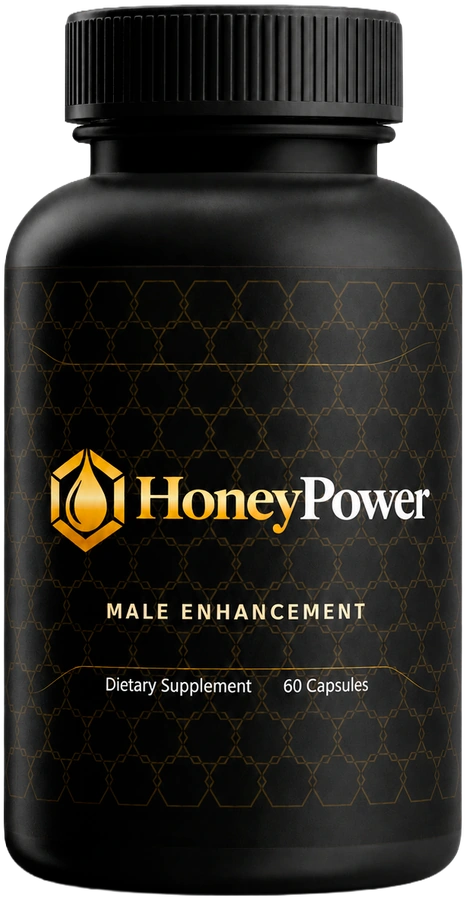
See where ginseng sits on the HoneyPower label
Panax ginseng is named second of 6 and no preparation, standardisation or amount is published for it. The ingredients page prints the trial doses above beside the name instead.
One bottle $69 · six bottles $294 · 180-day money-back guarantee
Order HoneyPower On The Official WebsiteTwo capsules a day · 60 per bottle · lot HON-26/GE-4888
What this means inside a six-ingredient capsule
Put the two constraints together. The trials ran between 1,400 mg and 3,000 mg a day of a specified ginseng preparation. A two-capsule daily serving holds somewhere around 1,400 mg of powder in total if both capsules are large ones.
So even a capsule that was entirely ginseng, with none of the other five ingredients in it, would sit at the very bottom of the range the trials used. Divided six ways, it is not in the same conversation.
There is a fair objection to that arithmetic and it deserves an answer. Concentrated extracts exist: a 10:1 extract delivers the constituents of ten times its weight in raw root, and the performance trial above used a concentrated ginsenoside complex at 500 mg rather than whole root at three grams. A label that printed a standardisation could argue this properly. A label that prints only a species name cannot, because there is no figure on it to argue from.
Four questions worth asking of any ginseng row
- Which ginseng? Red, white, berry or tissue-cultured. The species name alone does not answer it.
- Standardised to what? A ginsenoside percentage turns a weight into something comparable with a trial.
- How much? The trials ran at 1,400 to 3,000 mg a day of specified material. Anything well below that needs a standardisation to justify itself.
- Am I on warfarin or another anticoagulant? If so, this is the ingredient to raise before the first capsule rather than after it.
Ginseng is the strongest evidence on this shelf and the evidence is still rated low certainty. Every trial behind it named a dose, and those doses run from 1,400 to 3,000 milligrams a day of a specified preparation. That is the number to hold any panel against, and where a panel prints no number at all it is the only number a reader has.
References
- Lee HW, Lee MS, Kim TH, et al. Ginseng for erectile dysfunction. Cochrane Database Syst Rev. 2021;4(4):CD012654. PMID 33871063. https://pubmed.ncbi.nlm.nih.gov/33871063/
- de Andrade E, de Mesquita AA, Claro Jde A, et al. Study of the efficacy of Korean Red Ginseng in the treatment of erectile dysfunction. Asian J Androl. 2007;9(2):241-4. PMID 16855773. https://pubmed.ncbi.nlm.nih.gov/16855773/
- Kim TH, Jeon SH, Hahn EJ, et al. Effects of tissue-cultured mountain ginseng (Panax ginseng CA Meyer) extract on male patients with erectile dysfunction. Asian J Androl. 2009;11(3):356-61. PMID 19234482. https://pubmed.ncbi.nlm.nih.gov/19234482/
- Choi YD, Park CW, Jang J, et al. Effects of Korean ginseng berry extract on sexual function in men with erectile dysfunction: a multicenter, placebo-controlled, double-blind clinical study. Int J Impot Res. 2013;25(2):45-50. PMID 23254461. https://pubmed.ncbi.nlm.nih.gov/23254461/
- Lee ES, Yang YJ, Lee JH, Yoon YS. Effect of high-dose ginsenoside complex (UG0712) supplementation on physical performance of healthy adults during a 12-week supervised exercise program: A randomized placebo-controlled clinical trial. J Ginseng Res. 2018;42(2):192-198. PMID 29719466. https://pubmed.ncbi.nlm.nih.gov/29719466/
- Jung DH, Lee YJ, Kim CB, et al. Effects of ginseng on peripheral blood mitochondrial DNA copy number and hormones in men with metabolic syndrome: A randomized clinical and pilot study. Complement Ther Med. 2016;24:40-6. PMID 26860800. https://pubmed.ncbi.nlm.nih.gov/26860800/
- Yuan CS, Wei G, Dey L, et al. Brief communication: American ginseng reduces warfarin's effect in healthy patients: a randomized, controlled trial. Ann Intern Med. 2004;141(1):23-7. PMID 15238367. https://pubmed.ncbi.nlm.nih.gov/15238367/
Order HoneyPower with the ginseng numbers in front of you
Three packs, 180 days from purchase, and the trial dose printed beside every one of the six names on the ingredients page.
One bottle $69 · six bottles $294 · 180-day money-back guarantee
Order HoneyPower On The Official WebsiteTwo capsules a day · 60 per bottle · lot HON-26/GE-4888