HoneyPower Official Website › Blog › Testosterone And Age
Testosterone And Age: What Changes After 40, And What A Capsule Can’t Reverse
HoneyPower's sales page names healthy testosterone, as printed, among what the formula supports. Before weighing any ingredient against that claim, it helps to know the baseline it is being measured against: testosterone changes with age on its own, in every large study that has tracked it, independent of any supplement. This article lays out what five separate longitudinal studies found, because a number on a lab report only means something next to that context.
- The Baltimore Longitudinal Study of Aging, tracking healthy men over decades, found total testosterone fell by about 0.4% a year on average and free testosterone fell faster, about 1.2% a year, with the rate accelerating in a man's sixties and seventies.
- A 2026 study of 27,687 Korean men aged 40 and over found the same downward pattern and identified metabolic factors, weight and blood sugar among them, as significant determinants of how fast it happens.
- A UK Biobank study looking at genetics alongside age found a real genetic contribution to how much and how fast testosterone falls, meaning two men of the same age do not decline at the same rate.
- None of these studies measured any supplement. They describe the natural trajectory testosterone follows with age, which is the baseline any ingredient's effect has to be measured against, not the effect itself.
- A single low testosterone reading is not a diagnosis. The Endocrine Society's own clinical guideline requires two separate morning blood draws before hypogonadism is even considered.
What the label claims, and what it leaves out
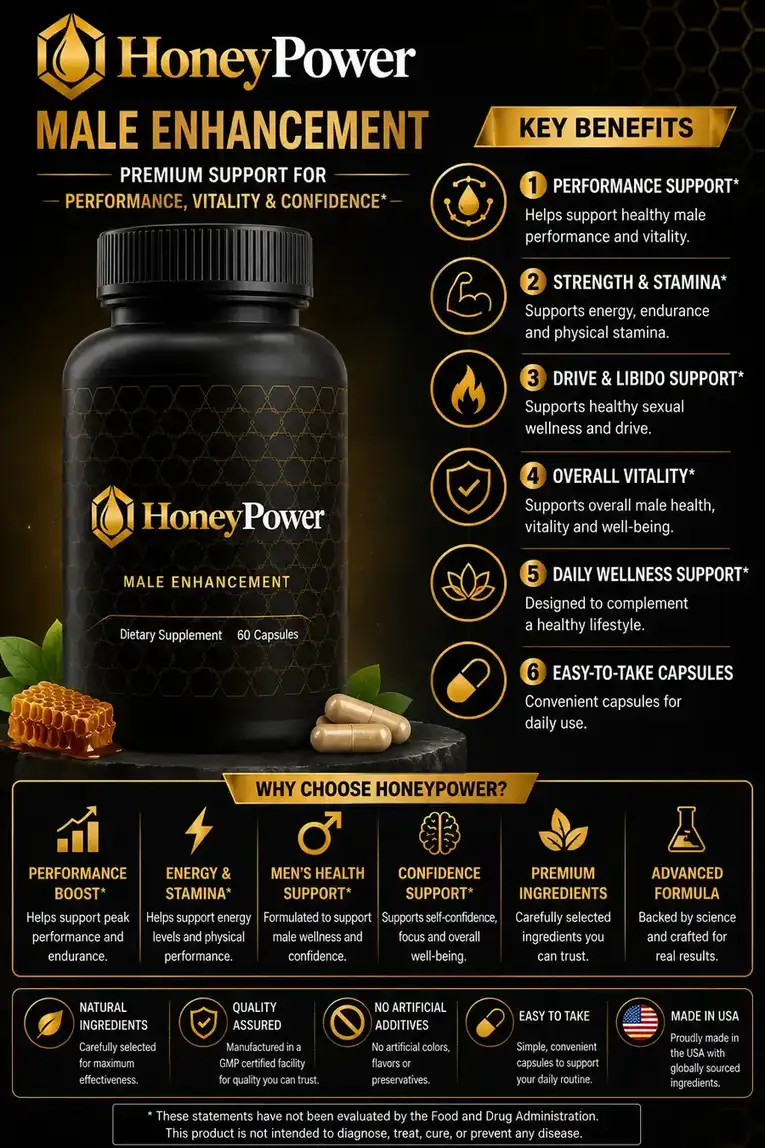
The HoneyPower sales page lists healthy testosterone, as printed, as one of three things this formula supports, alongside blood circulation and energy and stamina. The word "as printed" is doing real work in that sentence: it signals the seller is quoting its own label language rather than making an independent claim, and it appears with the standard note that these statements have not been evaluated by the FDA.
What the label does not say is more important here than what it does. It does not name which ingredient is meant to affect testosterone, does not cite a study, and does not mention that testosterone declines with age in every man regardless of what he takes. That last omission matters because it changes what evidence would actually be needed to support the claim. A study showing testosterone was higher in a treated group than in an untreated group of the same age is meaningfully different from a before-and-after number in one man, because age alone would move that second number down over time with nothing else changing.
The Baltimore study: decades of the same men, tracked
The single most cited study on this question is the Baltimore Longitudinal Study of Aging, published by Harman and colleagues in 2001 in the Journal of Clinical Endocrinology and Metabolism. It is not a snapshot comparison of young men against old men, which can be confounded by generational differences in health and lifestyle. It is a true longitudinal study: the same healthy male volunteers, tracked with repeated blood draws over an average of nine years each, some for far longer.
The results: total testosterone fell by an average of about 0.4% a year, cumulatively enough that a substantial share of men in their seventies and eighties fell below the threshold the researchers used to define a low level. Free testosterone, the smaller fraction not bound to carrier proteins in blood and considered more biologically active, fell faster, at roughly 1.2% a year, because sex hormone binding globulin, the protein that binds it, tends to rise with age and mops up more of the total pool. The decline was not perfectly linear. It accelerated somewhat in the oldest men studied. And it was not universal at the individual level: some men in their seventies had testosterone levels comparable to men decades younger, which the authors noted as a reason age alone cannot predict any one man's number.
| Study | Population | Finding |
|---|---|---|
| Harman 2001 (Baltimore Longitudinal Study) | Healthy men, tracked ~9 years each | Total T down ~0.4%/yr; free T down ~1.2%/yr; decline accelerates with age |
| 2026 Korean cohort | 27,687 men, age 40+ | Same downward trend; weight and metabolic markers significantly affect the rate |
| Harman 2007 (Australian men) | Population-based sample | Confirmed age-related decline pattern outside a US cohort |
| 2022 study, men 40-69 | Longitudinal, repeated draws | Confirmed continued decline through late-40s to 60s range |
| UK Biobank genetics study | Large population genetic dataset | Genetic variants significantly affect individual decline rate |
Every figure above is drawn from the cited study's own reported results. None of these studies tested a supplement; they describe the age-related trajectory testosterone follows on its own.
27,687 men, and what moves the rate
A far larger and more recent study, published in the World Journal of Men's Health in 2026, examined 27,687 Korean men aged 40 and older. Its scale lets it do something the smaller Baltimore cohort could not: identify which factors, beyond age itself, are statistically associated with a faster or slower decline. The study reported that metabolic determinants, including body weight and markers related to blood sugar control, were significantly associated with how quickly testosterone fell in a given man.
This is a useful finding for a different reason than the headline number. It means the rate of decline is not fixed by age alone. Weight and metabolic health, both modifiable, measurably affect the slope of the curve. That is consistent with what the weight, exercise and sleep article on this blog covers from the intervention side: lifestyle trials that produced weight loss in obese men also produced testosterone increases, on a similar order of magnitude to what a modest supplement effect might claim.
See where the testosterone claim sits on the full label
Healthy testosterone, as printed, is one of three lines on the benefits panel. The ingredients page sets every name beside the dose its own research used.
One bottle $69 · six bottles $294 · 180-day money-back guarantee
Order HoneyPowerTwo capsules a day · 60 per bottle
The UK Biobank: why two 50-year-olds are not the same case
A 2025 study using the UK Biobank, a genetic and health database covering roughly half a million people, looked specifically at how much of the variation in age-related testosterone decline is explained by genetics rather than environment or chance. It found a real, measurable genetic contribution: specific genetic variants were associated with both baseline testosterone level and the rate at which it fell with age.
The practical takeaway is not that genetics determines everything. It is that age is one input among several, alongside weight, metabolic health and inherited variation, and that two men of the same age can have meaningfully different starting points and different trajectories. That variability is also why a testosterone claim printed on a label, tested or not, cannot promise a specific outcome for a specific man: the studies this article cites describe population averages and the factors that move them, not individual guarantees.
Why a single number is not a diagnosis
The Endocrine Society's clinical practice guideline on testosterone therapy, published in 2018, is explicit on this point: a diagnosis of low testosterone, clinically called hypogonadism, is not made from a single blood draw, and it is not made from how a man feels on a given afternoon. It requires morning blood draws, when testosterone is at its daily peak, repeated on two separate occasions, along with consistent symptoms. A number that would look low if drawn at 4pm, when testosterone is naturally lower for circadian reasons unrelated to any supplement, can look entirely normal on a proper morning draw.
This matters for reading any testosterone-support claim, including this one, because it means the relevant comparison is never one number against another. It is a repeated, properly timed measurement against reference ranges that already account for age. A man in his fifties is not being compared to a man in his twenties on the same chart; age-adjusted context is part of how the number is read in the first place.
What this means for reading the label’s claim
None of the five studies above tested HoneyPower, or any of its six named ingredients, against testosterone as an outcome. They describe the backdrop the claim sits in front of: a hormone that reliably falls with age, at a rate influenced by weight and metabolic health and, to a real degree, genetics. A reader evaluating whether a testosterone-support claim on any label is doing something beyond that natural backdrop would need to see a controlled comparison, ideally against a placebo group of similar age, not simply a before-and-after number in men who are also a year or two older by the time it is measured again.
That does not make the printed claim false. It means the honest baseline for judging it is the decline described above, roughly 0.4% a year in total testosterone and faster for the free fraction, accelerating in later decades and moved by weight and metabolic health along the way. Ingredient-specific testosterone evidence for tribulus terrestris is covered separately in the tribulus article, and the same question for maca is covered in the maca dose article, both on this blog.
Testosterone declines with age on its own, in every large longitudinal study that has measured it: roughly 0.4% a year in total testosterone in the Baltimore Longitudinal Study of Aging, faster for the free fraction, and confirmed in Australian, and other cohorts through the 40s and 60s. A 2026 study of 27,687 Korean men found weight and metabolic health significantly affect the rate, and a UK Biobank study found a real genetic contribution. None of these studies tested a supplement. A single low reading is not a diagnosis; the Endocrine Society requires two separate morning draws before hypogonadism is even considered.
References
- Harman SM, Metter EJ, Tobin JD, Pearson J, Blackman MR. Longitudinal effects of aging on serum total and free testosterone levels in healthy men. Baltimore Longitudinal Study of Aging. J Clin Endocrinol Metab. 2001;86(2):724-31. PMID 11158037. https://pubmed.ncbi.nlm.nih.gov/11158037/
- Age-Related Testosterone Decline and Metabolic Determinants in 27,687 Korean Men Aged ≥40 Years. World J Mens Health. 2026. PMID 42220225. https://pubmed.ncbi.nlm.nih.gov/42220225/
- Age-related changes in serum testosterone and sex hormone binding globulin in Australian men. J Clin Endocrinol Metab. 2007. PMID 17595245. https://pubmed.ncbi.nlm.nih.gov/17595245/
- Longitudinal changes in serum testosterone and sex hormone-binding globulin in men aged 40-69 years. Clin Endocrinol (Oxf). 2022. PMID 34873743. https://pubmed.ncbi.nlm.nih.gov/34873743/
- Role of genetics in the age-related testosterone decline in men: a UK Biobank study. Eur J Endocrinol. 2025. PMID 40673695. https://pubmed.ncbi.nlm.nih.gov/40673695/
- Bhasin S, Brito JP, Cunningham GR, et al. Testosterone Therapy in Men With Hypogonadism: An Endocrine Society Clinical Practice Guideline. J Clin Endocrinol Metab. 2018;103(5):1715-1744. PMID 29562364. https://pubmed.ncbi.nlm.nih.gov/29562364/
Read the age-adjusted baseline before judging the claim
Three months, the length of two bottles, is far shorter than the years these studies tracked. The 180-day window covers a proper look either way.
One bottle $69 · six bottles $294 · 180-day money-back guarantee
Order HoneyPowerTwo capsules a day · 60 per bottle