HoneyPower Official Website › Blog › Lifestyle Trials
Weight, Exercise And Sleep: What Changing Them Did In The Trials
Nobody sells a bottle by telling you to walk more and sleep longer, which is exactly why the trials on those two things are worth reading next to the trials on capsules. This article lays out what actually happened to erectile function and testosterone when men in randomised studies lost weight, started exercising or had their sleep cut short, with the numbers attached and the caveats left in.
- In a 110-man randomised trial, obese men with erectile difficulty who lost weight and exercised more for two years improved their erectile function score, and 17 of 55 reached a normal-range score against 3 of 55 in the comparison group.
- A meta-analysis of 11 randomised trials found aerobic exercise raised the erectile function domain score by 2.8 points on average, with larger gains in men who started lower.
- Weight loss was associated with a rise in testosterone across 24 studies, and the size of the rise tracked how much weight was lost.
- Sleep restriction is the shakiest of the three: two small controlled studies in young healthy men did not find a clear fall in total testosterone.
- None of this is a promise about any individual man. It is a picture of what changed in groups, over months, in people who did the work.
Why put a lifestyle trial beside a capsule trial
Every ingredient on the HoneyPower artwork has its own page on this website, and most of them carry the same uncomfortable finding: the human research is small, short, or run on a dose the bottle does not print. Reading that repeatedly can leave the impression that there is nothing better on offer, so this article does the opposite job. It asks what the best-evidenced non-supplement things do when they are tested the same way.
There is a fair objection to the comparison. Losing weight is hard, a capsule is easy, and a trial that rewards a man for doing something difficult tells him nothing about whether a convenient thing also works. That is true, and nothing below argues that the two are rivals. The point is narrower. When you read a supplement claim, it helps to know what size of change a real intervention produces, because that gives you a yardstick for everything else.
The earlier article on when the problem is not something a capsule reaches covers the association side: population studies linking sleep, weight, smoking, alcohol and activity to sexual function. This one covers the intervention side, which is a different and harder kind of evidence. An association says two things travel together. A randomised trial says what happened when somebody changed one of them on purpose.
The two-year weight and activity trial
Esposito and colleagues ran the study most often quoted on this subject, and it is worth reading for how it was built as much as for what it found. It was a randomised, single-blind trial of 110 obese men, body mass index 30 or above, aged 35 to 55, at a university hospital in Italy between October 2000 and October 2003. None of them had diabetes, hypertension or high blood fats, and all of them had erectile difficulty, defined as an International Index of Erectile Function score of 21 or less.
Fifty-five men were assigned to the intervention. They received detailed advice on losing 10 percent or more of their body weight by eating less and moving more. The other 55 were given general information about healthy food choices and exercise, which is roughly what a well-meaning doctor hands out in a corridor. That contrast matters: the comparison group was not left alone, it was given the standard leaflet.
After two years the two groups looked very different.
| Measure at two years | Intervention group | Comparison group |
|---|---|---|
| Body mass index | 36.9 down to 31.2 | 36.4 down to 35.7 |
| Physical activity, minutes a week | 48 up to 195 | 51 up to 84 |
| Erectile function score | 13.9 up to 17 | 13.5 to 13.6, unchanged |
| Men scoring 22 or higher | 17 of 55 | 3 of 55 |
All figures are from the trial's own abstract. The score is the International Index of Erectile Function total described in the trial.
Three things stand out. First, the average gain was real but modest: about three points on a scale where the men started near 14. Second, the group-level improvement hid a wide spread, because 17 of 55 men crossed the line into the normal range and the rest did not. The authors summarised it as improvement in about one third of obese men who had erectile difficulty at baseline. Third, the inflammatory markers moved too. Interleukin 6 and C-reactive protein fell in the intervention group, and changes in body mass index, activity and C-reactive protein were each independently associated with the change in score.
What this trial cannot tell you is what happens in a man who is not obese, or one who already has diabetes or high blood pressure, because those men were excluded on purpose. It also cannot separate weight from exercise, since the two moved together by design. And it took two years. Anybody who reads it as a fortnight's project has misread it.
The same idea in men with diabetes
The obvious follow-up is what happens in men whose erectile difficulty comes with type 2 diabetes, which is a harder population. Wing and colleagues looked at exactly that inside the Look AHEAD trial. Overweight or obese men with type 2 diabetes had been randomised either to diabetes support and education or to an intensive lifestyle programme built around weight loss and activity. Men at five of the clinical sites completed the erectile function questionnaire at baseline (372 men) and at one year (306, which is 82 percent).
The intensive group lost 9.9 percent of initial body weight against 0.6 percent, and fitness rose 22.7 percent against 4.6 percent. Erectile function improved more in the intensive group, from 17.3 to 18.6, than in the education group, from 18.3 to 18.4. The p value was 0.04 before adjusting for baseline differences and 0.06 after, which is the sort of result that deserves a raised eyebrow rather than a headline.
The more useful numbers were about direction. Among men in the intensive programme, 8 percent got worse, 70 percent stayed in the same category and 22 percent improved. Among the education group, 20 percent got worse, 57 percent stayed the same and 23 percent improved. The authors' own conclusion was careful: in older overweight or obese men with diabetes, weight loss was mildly helpful in maintaining erectile function. Maintaining is the operative word. The gain was mostly a smaller share of men getting worse.
Put the two trials side by side and the pattern is sensible. The earlier and less complicated the situation, the more a lifestyle change appears to help. In a man who already has diabetes and years of vascular wear, it shifts the odds a little.
What exercise alone did, across two meta-analyses
Two systematic reviews have pooled the exercise trials, and they agree closely on direction while differing on size.
Silva and colleagues searched six databases up to July 2016 and found seven eligible randomised trials with 478 men who had a diagnosis of erectile dysfunction. The interventions were aerobic, pelvic floor or combined exercise, and follow-up ranged from 8 weeks to 2 years. Pooled, the erectile function score improved by a mean of 3.85 points (95 percent confidence interval 2.33 to 5.37). The authors were candid that risk of bias was moderate to high, mainly because nobody can be blinded to whether they are exercising. Their reading was that the benefit was clearest for aerobic exercise at moderate to vigorous intensity.
Khera, Bhattacharyya and Miller restricted themselves to aerobic exercise measured on the erectile function domain of the questionnaire, which runs from 6 to 30. Eleven randomised trials qualified. The pooled difference against non-exercising controls was 2.8 points (95 percent confidence interval 1.7 to 3.9), with moderate heterogeneity. The detail that matters most is the gradient: the improvement was 2.3 points in men with mild erectile dysfunction, 3.3 in moderate and 4.9 in severe. Men who started lower gained more, which is what you would expect if there is more room to move.
Neither review says exercise cures anything, and neither should be read that way. What they do establish is that a free intervention, tested across several trials and hundreds of men, moves the same score that supplement trials are judged on, by an amount in the same range as the 3.52 points the Cochrane review of ginseng pooled on the same domain. Whether a given change is large enough to notice is a separate question, and one the article on how a trial measures erectile function takes up properly.
Keep the routine, then look at the bottle
HoneyPower is two capsules a day with water, 60 to a bottle. It is a dietary supplement, and the lifestyle changes above are where the larger measured effects sit.
One bottle $69 · six bottles $294 · 180-day money-back guarantee
Order HoneyPower On The Official WebsiteTwo capsules a day · 60 per bottle · lot HON-26/GE-4888
Weight, and what happened to testosterone
A great deal of this aisle is sold on the word testosterone, so it is fair to ask what moves it in men in general. Corona and colleagues pooled 24 studies, 22 of which looked at diet or bariatric surgery and 2 of which compared the two. Both a low-calorie diet and bariatric surgery were associated with a significant rise in total testosterone (P below 0.0001 against baseline). The pooled increase was 2.87 with a low-calorie diet and 8.73 with bariatric surgery, the review's own figures, with surgery producing the larger rise.
Two further details from that abstract are worth carrying. The rise was greater in men who lost more weight, and multiple regression identified the degree of weight loss as the best single determinant of the testosterone rise. The rise was also greater in younger men without diabetes who started with a higher degree of obesity. The review also recorded a decrease in estradiol and an increase in gonadotropins with weight loss.
Notice what this does and does not say. It says that in obese men, taking off weight is associated with a higher testosterone reading, and that the more comes off, the more it rises. It does not say a man of ordinary weight can raise his testosterone by dieting, and it does not say a higher reading automatically means better erections. Those are different questions, and the answer to each is more complicated than a headline.
It also puts a useful frame around the word on the bottle. The seller's sales page names healthy testosterone among the things the product supports. Beside that, the best-documented lever on testosterone in the published literature is body weight, and it is one that no capsule replaces.
Sleep, where the evidence is thinner than the internet suggests
Sleep is the third lifestyle claim, and it is the one most commonly overstated. The tidy version says short sleep lowers testosterone, so sleep more. The controlled trials are less tidy.
Reynolds and colleagues put 14 healthy men aged around 27 through a laboratory protocol: two baseline nights of 10 hours in bed, then five nights of 4 hours, then a recovery night. Food intake was controlled at about 2,000 kilocalories a day. After the restricted nights, glucose, insulin, cortisol and leptin were up and sex hormone binding globulin was down, but total testosterone did not change significantly (P = 0.089). The authors read the pattern as short sleep affecting glucose handling and adrenal reactivity.
Smith and colleagues ran two randomised studies in young healthy men. In the first, 14 men spent five nights on 4 hours in bed against 9 hours, and there was no significant effect on testosterone concentrations (P = 0.13 for the main effect of sleep duration). In the second, 13 men had a milder sleep restriction sustained for six weeks. There was a trend for an interaction (P = 0.067) and a main effect of sleep (P = 0.0046), but testosterone was only slightly lower and rose over time in the restricted condition. The authors concluded that sleep restriction did not adversely affect plasma testosterone in healthy young men, while noting prior contradicting evidence and calling for confirmatory work.
So the honest position is that the sleep and testosterone link is contested in the controlled data, that the studies are small (13 and 14 men), and that they were done in young healthy volunteers, not in the middle-aged men this product is aimed at. None of that makes sleep unimportant. The five-night laboratory study, for one, showed measurable effects on glucose and cortisol. It means a sentence promising that eight hours will fix a hormone is running ahead of the evidence.
Where a capsule sits in this picture
Set the three lifestyle levers beside the supplement trials and a rough scale emerges. The weight and activity trial moved the erectile function score by about three points over two years. The exercise reviews pooled to between 2.8 and 3.85 points. Weight loss raised testosterone in a dose-related way. Sleep restriction was inconclusive for testosterone but not neutral for metabolism.
| Lever | What the trials measured | The catch |
|---|---|---|
| Weight loss plus activity | Erectile function score up about 3 points over 2 years in obese men | Two years, and men with diabetes or hypertension were excluded |
| Aerobic exercise | Pooled gain of 2.8 points across 11 trials; larger when baseline was lower | Diverse groups, no blinding possible |
| Weight loss and testosterone | Rise across 24 studies, larger with more weight lost | Obese men; unclear for men of ordinary weight |
| Sleep | Glucose and cortisol changed; total testosterone did not clearly change | 13 and 14 young healthy men; contested |
The bottle in front of you fits none of these rows. It is a capsule, and the seller prints no amount for any of its six ingredients.
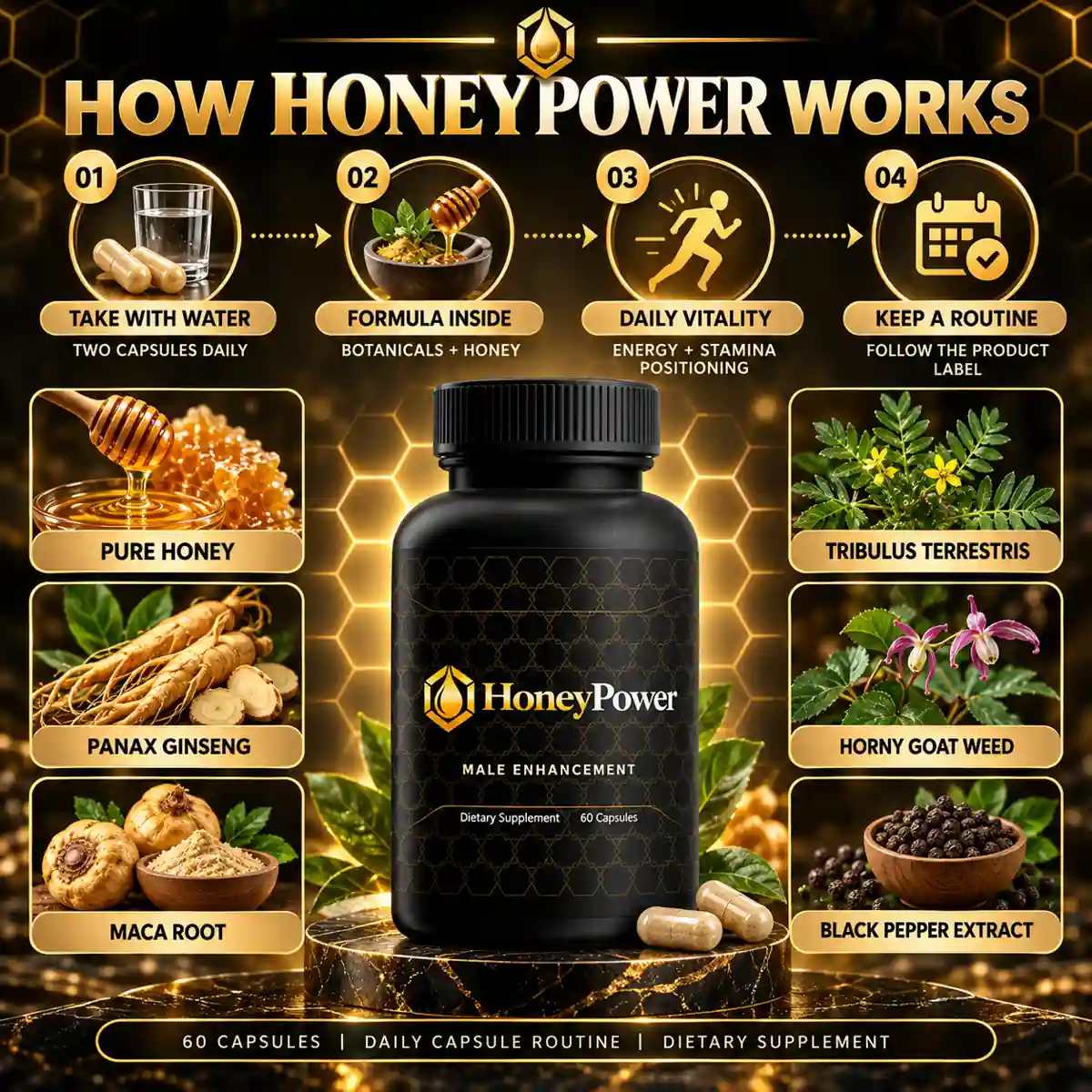
That is where an honest article about this product has to land. HoneyPower is a capsule taken twice a day, and its own how-it-works sheet ends with the instruction to keep a routine and follow the label. The ingredients page sets each of the six names beside the dose its own research used, which is the only comparison this label permits. The lifestyle trials above are not an argument against a capsule. They are an argument for knowing the size of the effects you are comparing, and for not letting a small, uncertain, supplement-sized effect substitute for a large, well-tested, free one.
If you do decide to try the bottle, the sensible approach borrows from these trials. Change one thing at a time so you know what did what. Write down a baseline. Give it the span the ingredient research used rather than a week. The results timeline sets out how the seller's typical wait of three to four weeks compares with the eight to twelve weeks its two best-studied ingredients were tested over, and the guarantee page explains how the 180-day window is counted.
Four questions before you buy anything
- What else is changing? If you start a supplement and a new walking habit in the same fortnight, you cannot say which one did what. The lifestyle trials above suggest the walking is the more likely contributor.
- How long is the yardstick? Two years, one year, eight weeks. Ask how long the cited trial ran before accepting a claim that sounds like it takes days.
- Who was in the trial? Obese, diabetic, young and healthy, or a mix. Findings travel badly between those groups.
- Is a change of about three points the kind of change you are hoping for? If so, several of the routes above are on the table. If you are hoping for more, it is worth asking a doctor rather than a shop.
Losing weight, moving more and, more tentatively, sleeping enough have all been tested in randomised trials. The gains are measurable and modest, they take months, and they help most where the starting point is furthest from healthy. A capsule can sit alongside those changes, but it cannot be the thing that makes them unnecessary. Read every number above as a group average from a specific kind of man, and none of them as a forecast for you.
References
- Corona G, Rastrelli G, Monami M, Saad F, Luconi M, Lucchese M, et al. Body weight loss reverts obesity-associated hypogonadotropic hypogonadism: a systematic review and meta-analysis. Eur J Endocrinol. 2013;168(6):829-43. PMID 23482592. https://pubmed.ncbi.nlm.nih.gov/23482592/
- Esposito K, Giugliano F, Di Palo C, Giugliano G, Marfella R, D'Andrea F, et al. Effect of lifestyle changes on erectile dysfunction in obese men: a randomized controlled trial. JAMA. 2004;291(24):2978-84. PMID 15213209. https://pubmed.ncbi.nlm.nih.gov/15213209/
- Khera M, Bhattacharyya S, Miller LE. Effect of aerobic exercise on erectile function: systematic review and meta-analysis of randomized controlled trials. J Sex Med. 2023;20(12):1369-1375. PMID 37814532. https://pubmed.ncbi.nlm.nih.gov/37814532/
- Lee HW, Lee MS, Kim TH, Alraek T, Zaslawski C, Kim JW, et al. Ginseng for erectile dysfunction. Cochrane Database Syst Rev. 2021;4(4):CD012654. PMID 33871063. https://pubmed.ncbi.nlm.nih.gov/33871063/
- Reynolds AC, Dorrian J, Liu PY, Van Dongen HP, Wittert GA, Harmer LJ, et al. Impact of five nights of sleep restriction on glucose metabolism, leptin and testosterone in young adult men. PLoS One. 2012;7(7):e41218. PMID 22844441. https://pubmed.ncbi.nlm.nih.gov/22844441/
- Silva AB, Sousa N, Azevedo LF, Martins C. Physical activity and exercise for erectile dysfunction: systematic review and meta-analysis. Br J Sports Med. 2017;51(19):1419-1424. PMID 27707739. https://pubmed.ncbi.nlm.nih.gov/27707739/
- Smith I, Salazar I, RoyChoudhury A, St-Onge MP. Sleep restriction and testosterone concentrations in young healthy males: randomized controlled studies of acute and chronic short sleep. Sleep Health. 2019;5(6):580-586. PMID 31416797. https://pubmed.ncbi.nlm.nih.gov/31416797/
- Wing RR, Rosen RC, Fava JL, Bahnson J, Brancati F, Gendrano Iii IN, et al. Effects of weight loss intervention on erectile function in older men with type 2 diabetes in the Look AHEAD trial. J Sex Med. 2010;7(1 Pt 1):156-65. PMID 19694925. https://pubmed.ncbi.nlm.nih.gov/19694925/
More about HoneyPower
A capsule beside the routine, not instead of it
Two capsules a day, 60 to a bottle, and 180 days from purchase to make up your mind. The lifestyle changes above are where the larger measured effects sit.
One bottle $69 · six bottles $294 · 180-day money-back guarantee
Order HoneyPower On The Official WebsiteTwo capsules a day · 60 per bottle · lot HON-26/GE-4888