HoneyPower Official Website › Blog › Honey In A Capsule
How Much Honey Actually Fits Inside A Capsule?
Honey has a genuine research literature and a genuine dose to go with it. The dose is measured in grams. A capsule is measured in milligrams, and there are a thousand of those in one gram, which is the whole of the problem in one sentence of arithmetic.
- The cardiometabolic research on honey pools at around 10 grams a day, which is 10,000 milligrams.
- The sports-nutrition work uses more still, at the sort of quantity a sports drink delivers rather than a capsule.
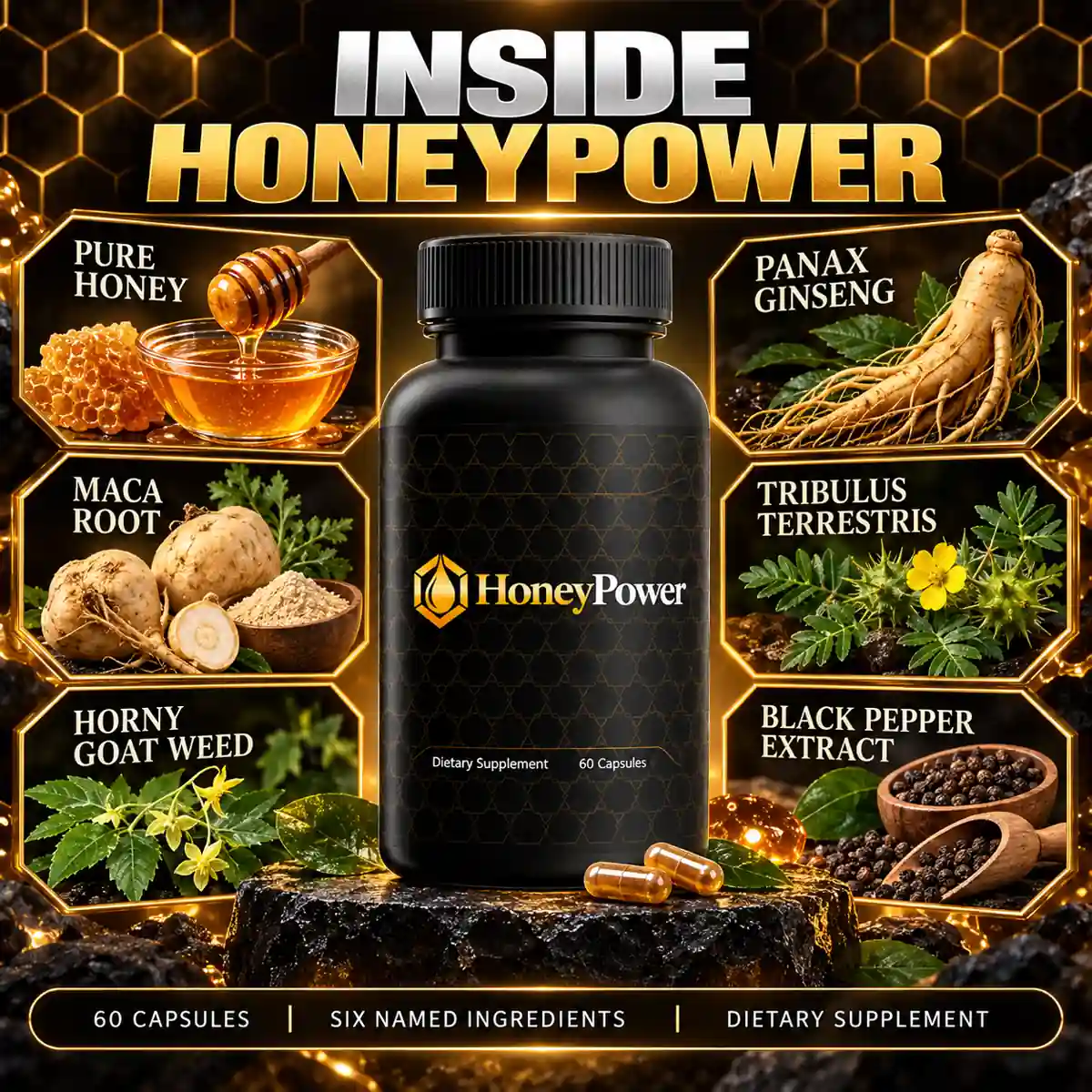
- A size-00 capsule holds roughly 700 mg of powder. Two of them, split six ways, leave a couple of hundred milligrams per ingredient.
- Honey is also a syrup, so getting it into a capsule at all means drying it onto a carrier, which adds weight that is not honey.
- None of that makes honey a bad ingredient. It makes it a flavour, a binder and a brand signature rather than an active dose.
Honey has two research literatures and neither is about drive
Honey is one of the most studied foods on the planet, which surprises people who assume the research is folklore with citations. It is not. There are randomised trials, there are systematic reviews, and in 2025 there was an umbrella review pooling those reviews with GRADE ratings attached to the conclusions.
What that body of work is about, though, is metabolism and cardiovascular markers on one side and exercise fuelling on the other. Neither of those is the reason honey appears on a male vitality label, and a reader who goes looking for the trial that tested honey for drive will not find it.
The cardiometabolic side
the 2025 umbrella review is the anchor. It explored dosage across the effects of honey and its derivatives on cardiometabolic outcomes, pooling systematic reviews and running an updated meta-analysis with the certainty of each conclusion graded. The dose that work concentrates on is in the region of ten grams a day.
Ten grams is two teaspoons. It is a food quantity, eaten as food, and that is the level at which the measurable effects in that literature appear.
The exercise-fuelling side
a 2025 cycling trial put honey up against a conventional carbohydrate sports product across three hours of steady-state cycling followed by an exercise capacity test, and reported comparable metabolic responses. a soccer-simulation trial tested a honey-sweetened beverage against a soccer simulation and measured both performance and the cytokine response to the exercise.
Both of those are studies of honey as a carbohydrate. They are interesting, they are real, and the quantities involved are the quantities a sports drink carries rather than anything a capsule could hold.
| Where honey was studied | Daily amount | What the study measured |
|---|---|---|
| 2025 umbrella review, cardiometabolic outcomes | around 10 g | Pooled meta-analysis across systematic reviews, GRADE-assessed |
| 2025 steady-state cycling trial | a sports-drink quantity | Metabolic response over three hours, then an exercise capacity test |
| Soccer-simulation trial | a sweetened beverage | Performance and exercise-induced cytokine response |
| Any capsule on any shelf | a few hundred milligrams at most | Nothing. No trial has tested encapsulated honey for anything |
Three literatures, and the unit on the first three rows is grams. The unit on the fourth is milligrams, and a thousand of those make one of the others.
What a capsule physically holds
A two-piece gelatin or vegetable capsule is a container with a fixed internal volume, and what it holds depends on the density of whatever is poured into it. The standard consumer sizes are 1, 0 and 00, running from smallest to largest, and a size 00 is about as large as most people will swallow comfortably.
For a typical botanical powder, a size 0 takes something in the region of 500 mg and a size 00 something in the region of 700 mg. Denser powders take more and fluffier ones take less, which is why any figure quoted for a capsule size is a range rather than a number.
| Capsule size | Typical powder fill | As a share of 10 g |
|---|---|---|
| Size 1 | about 400 mg | 4% |
| Size 0 | about 500 mg | 5% |
| Size 00 | about 700 mg | 7% |
| Two size-00 capsules, one ingredient | about 1,400 mg | 14% |
| Two size-00 capsules split six ways | about 230 mg each | 2.3% |
Fill weights vary with the density of the powder, so treat these as the right order of magnitude rather than exact figures. The last row is the one that matters for any six-ingredient blend.
The last row of that table is the one that decides everything else. A capsule holding one ingredient holds a useful amount of it. A capsule holding six has to divide the same volume six ways, and the arithmetic does not care how the label is designed.
The arithmetic, done once and then left alone
Take the most generous assumptions available. Two size-00 capsules a day, filled to about 700 mg each, giving 1,400 mg of powder in total. Suppose honey took a quarter of that space, which would be an unusually large share for an ingredient listed first among six.
That is 350 mg of honey powder a day. The cardiometabolic literature works at 10,000 mg. The capsule delivers around three and a half per cent of it, and that is before anybody accounts for the carrier the powder is dried onto.
This is not a criticism aimed at one product. It is the arithmetic of encapsulating a food, and it applies identically to every capsule on every shelf that lists honey among its ingredients. The number is worth doing once so that it never has to be argued about again.
It does not mean honey in a capsule is inert, dishonest or pointless. It means the honey research does not transfer to the capsule, so a buyer should not be reading that research as if it did. Those are different statements and only the second one is being made here.
Honey is a liquid before anybody encapsulates it
There is a second constraint that gets less attention than the first and matters just as much. Honey at room temperature is a viscous, hygroscopic syrup. It is roughly four fifths sugar and one fifth water, and it pulls more water out of the air given the chance.
None of that behaves well inside a two-piece capsule. A hygroscopic syrup will soften gelatin, clump a blend and eventually fuse a capsule shut. So honey destined for a dry formula is spray-dried or drum-dried onto a carrier first, usually a starch or a maltodextrin, producing a free-flowing powder that handles like every other ingredient in the blend.
That carrier is part of the weight. A honey powder might be half honey solids and half carrier, so the already-small figure from the section above gets smaller again. It is a detail rather than a scandal, and it is the kind of detail a panel printing amounts would let you reason about.
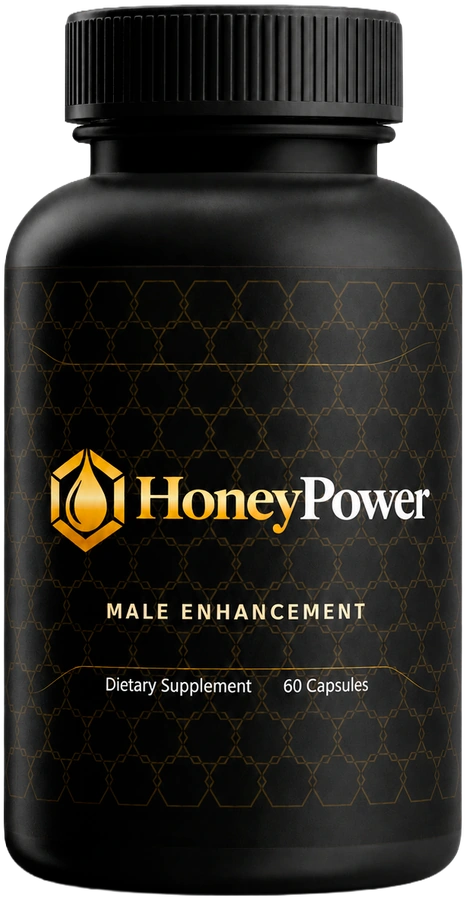
See where honey sits in the HoneyPower formula
Honey is named first of 6 on this bottle and no amount is published for it, so the ingredients page prints the dose the research used beside every name instead. Two capsules a day, 60 to a bottle.
One bottle $69 · six bottles $294 · 180-day money-back guarantee
Order HoneyPower On The Official WebsiteTwo capsules a day · 60 per bottle · lot HON-26/GE-4888
So what is honey doing in the formula?
Three honest jobs, none of which requires it to be an active ingredient.
The first is identity. A product called HoneyPower that did not contain honey would be selling something under a name it had no claim to. Naming honey first is a statement about what the brand is, and on that level it is doing exactly what it says.
The second is formulation. Dried honey powders carry flavour and behave as mild binders, which is useful in a blend of bitter botanicals. Tribulus and epimedium are not pleasant materials; anything that improves how a capsule smells when the bottle is opened is earning its place.
The third is cultural. Honey has been associated with vitality for as long as there has been writing about either, and a formula in this category that did not gesture at that tradition would be leaving something on the table commercially. That is marketing, it is not evidence, and the distinction is worth keeping clear rather than pretending the third job is the first one.
The two real safety notes about honey
Honey is a food with an unremarkable safety record in adults, and the two genuine cautions attached to it are worth stating precisely rather than vaguely.
The first is infants. the global review of infant botulism reviews the global epidemiology of infant botulism and honey exposure along with the prevention policies built around it, and the reason honey is kept away from children under twelve months is that their gut flora is not yet established enough to suppress Clostridium botulinum spores. This is an adults-only product, so the note is background rather than a live risk, but it is the single best-documented fact about honey safety and it belongs in any honest account of it.
The second is allergy. a 2026 pharmacovigilance overview of bee products is a 2026 pharmacovigilance overview of apitherapeutic products generally, covering the adverse events associated with bee-derived materials. Anybody with a known bee-product or pollen sensitivity has a reason to read an ingredient list carefully, and honey powder in a capsule is easier to miss than honey in a jar.
Reading a honey row on any label
Four things separate a label that is telling you something from one that is decorating a list.
- Is there an amount? Without one, nothing else on this list can be checked, and the honey row is a name rather than a fact.
- Is it honey or honey powder? Powder means a carrier, and a carrier means the printed weight is not all honey.
- Where does it sit in the order? Ingredient lists on supplement panels are conventionally in descending order of weight, so a first position carries information even when the amounts are absent.
- Does the marketing lean on honey research? If a page cites the cardiometabolic literature next to a capsule, check the dose in the paper against the dose in the capsule before accepting the connection.
Four questions worth asking about any honey ingredient
Does honey do anything at all in a supplement? As an excipient, yes: it carries flavour and binds a blend. As an active at capsule doses, there is no trial to point at.
Is raw honey different from processed honey here? In a jar, meaningfully. In a capsule, the material has been dried onto a carrier either way, so the distinction largely disappears.
Would a bigger capsule fix it? No. Reaching ten grams would take roughly fourteen size-00 capsules a day of pure honey powder, with no room for anything else in the bottle.
Should honey put me off a formula? It should not. It should stop you reading honey research as evidence for the capsule, which is a much narrower conclusion and the only one the arithmetic supports.
Honey's research is real, its dose is measured in grams, and a capsule is measured in milligrams. Everything else in this article follows from those three facts. Where a label prints no amount at all, the trial dose is the only number a reader has, and that is why this website prints it beside every name.
References
- Norouzzadeh M, Barazandeh S, Hasan Rashedi M, et al. Dosage exploration of the effects of honey and its derivatives on cardiometabolic outcomes: an overview of systematic reviews and GRADE-assessed updated meta-analysis. Nutr Diabetes. 2025;15(1):48. PMID 41261111. https://pubmed.ncbi.nlm.nih.gov/41261111/
- Fortis HO, Ravikanti S, Barrett JS, et al. Could It Bee? Honey Ingestion Induces Comparable Metabolic Responses to Traditional Carbohydrate-Based Sports Nutrition Product During 3-Hr Steady-State Cycling and Subsequent Exercise Capacity Test. Int J Sport Nutr Exerc Metab. 2025;35(5):424-432. PMID 40675563. https://pubmed.ncbi.nlm.nih.gov/40675563/
- Abbey EL, Rankin JW. Effect of ingesting a honey-sweetened beverage on soccer performance and exercise-induced cytokine response. Int J Sport Nutr Exerc Metab. 2009;19(6):659-72. PMID 20175433. https://pubmed.ncbi.nlm.nih.gov/20175433/
- Arico MO, Caselli D, Stefanizzi P, et al. Infant Botulism and Honey Exposure: Global Epidemiology, Prevention Policies, and Communication Strategies. Acta Paediatr. 2026;115(7):1429-1433. PMID 41964486. https://pubmed.ncbi.nlm.nih.gov/41964486/
- Rocha Filho LKA, Silva GI, Silva MS. Pharmacovigilance and toxicological risks associated with apitherapeutic products: a systematic overview. Arch Toxicol. 2026;100(2):425-436. PMID 41071287. https://pubmed.ncbi.nlm.nih.gov/41071287/
Read the six names first, then decide about HoneyPower
Six ingredients, the trial dose printed beside every one of them, two capsules a day and 60 capsules to a bottle. 180 days from purchase to change your mind.
One bottle $69 · six bottles $294 · 180-day money-back guarantee
Order HoneyPower On The Official WebsiteTwo capsules a day · 60 per bottle · lot HON-26/GE-4888